
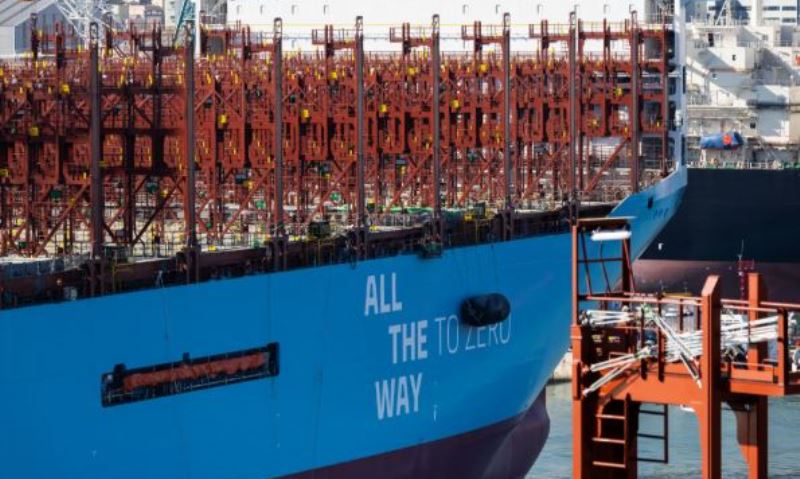
The world’s second-largest shipping company, Maersk of Denmark, is driving a fierce battle between South Korea and China as it prepares to place orders for up to 12 ultra-large, liquefied natural gas (LNG) dual-fuel container ships worth as much as 4 trillion Korean won ($2.5–2.8 billion).
The timing coincides with a new U.S. crackdown on Chinese shipping and shipbuilding. Beginning October 14, Washington will impose steep port entry fees on vessels both owned by Chinese companies and built in Chinese shipyards. While South Korea’s shipbuilders initially expected to benefit from the measures, industry observers say China remains a step ahead by leveraging aggressive pricing, state-backed financing, and faster delivery timelines.
U.S. ‘Port Fee Card’ Falls Short
Under the new rules, ships owned by Chinese operators will be charged $50 per ton, while vessels built in China will pay $18 per ton when entering U.S. ports. For an ultra-large container ship of 24,000 TEU capacity, the fees could reach 4 billion won per voyage.
Global banking group HSBC estimates the annual burden on China’s state-owned COSCO and its subsidiary OOCL could climb as high as $2.1 billion, equal to 5–7% of their sales. Yet the U.S. Trade Representative (USTR) ultimately limited the surcharge to Chinese-owned and Chinese-built ships, allowing non-Chinese carriers to sidestep the levy by deploying vessels from South Korea or Japan on U.S.-bound routes.
Industry insiders report that COSCO has already asked its shipping alliance partners—France’s CMA CGM and Taiwan’s Evergreen—to cover U.S. services with non-Chinese-built tonnage. The limited scope of Washington’s move has tempered South Korea’s hopes for a surge in orders.
China Retains Edge in Shipbuilding
Despite U.S. pressure, Chinese yards continue to attract record contracts. CMA CGM recently ordered 10 mega-ships worth $2.1 billion from Dalian Shipyard, while Switzerland’s MSC placed 20 newbuilding orders across five Chinese yards in July, beating out South Korean rivals.
South Korean builders maintain an advantage in green technology and quality, but shipowners remain focused on costs. Price differentials of up to 20% combined with Beijing’s state-backed financial packages, are tilting the balance toward China.
“Technology alone is not enough when China can bundle financing and deliver quicker,” an industry source said.
Suppose Maersk’s $2.8 billion order slips away. In that case, South Korea is expected to pivot toward securing contracts for large-scale LNG projects in Qatar and Mozambique, where its advanced technical expertise offers stronger leverage.