
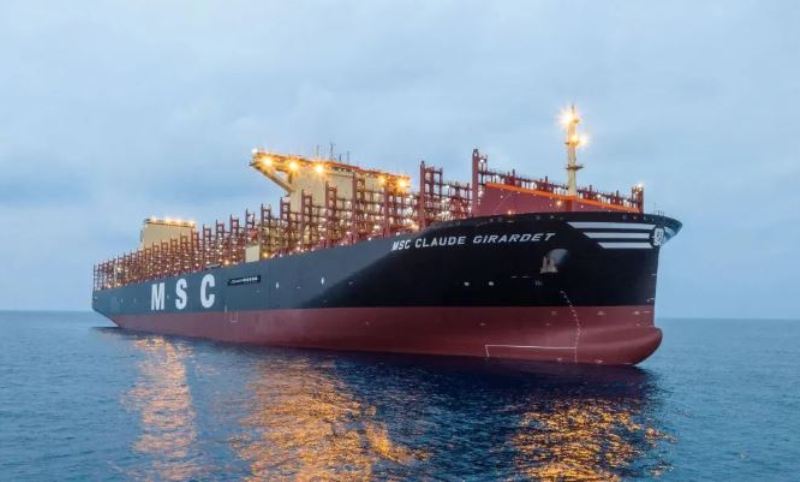
Undeterred by the threat of additional overcapacity, MSC has ordered a further ten 24,000 teu LNG dual-fuelled vessels from China’s Hengli Heavy Industry shipyard.
MSC has had a voracious appetite for fleet growth in recent months and now has a fleet capacity of 6.27m teu, of which owned tonnage makes up 3.07m, plus an orderbook of some 2.13m teu, including today’s order.
Already with capacity outweighing that of the Gemini Alliance and Ocean Alliance, MSC’s orderbook alone is a force to be reckoned with. As Lars Jensen, CEO of Vespucci Maritime, highlighted this morning: if the MSC orderbook were a carrier, it would be the world’s sixth-largest, just behind Hapag-Lloyd.
Due to be delivered in 2028, these ten newbuilds will add to the ten 21,000 teu LNG-fuelled ships ordered from Hengli in September the 12 19,000 teu vessels ordered in August from Zhoushan Changhong shipyard.
The new orders comply with MSC’s LNG-first strategy, what Alphaliner recently dubbed a “bet on LNG”, to meet its decarbonisation goals.
“MSC… was fairly late to new fuels, but then embraced LNG at a scale that no other industry player was able to match. With the exception of a few smaller vessels the carrier’s current orderbook is now exclusively LNG,” said Alphaliner.
According to calculations by shipbroker Braemar, unveiled this week, the deluge of new deliveries assailing the market will bring containership overcapacity to 7%-8% next year – net of the Cape of Good Hope diversions.
Braemar had predicted overcapacity would reach 12%-13% this year, but that was before the Cape diversions brought this down to 3%-4%. However, if the situation in the Red Sea were to be unexpectedly resolved next year, the tonnage overhang would be catastrophic for shipowners.
To put this in perspective, a peak of 11% idle containership tonnage was seen in 2009, a year after the global financial crisis – a symptom of a chronic oversupply which held down freight rates and hurt container lines’ bottom-lines until 2019.
Apparently seeking growth at all costs, perhaps MSC aims to be the only ship operator left standing.