
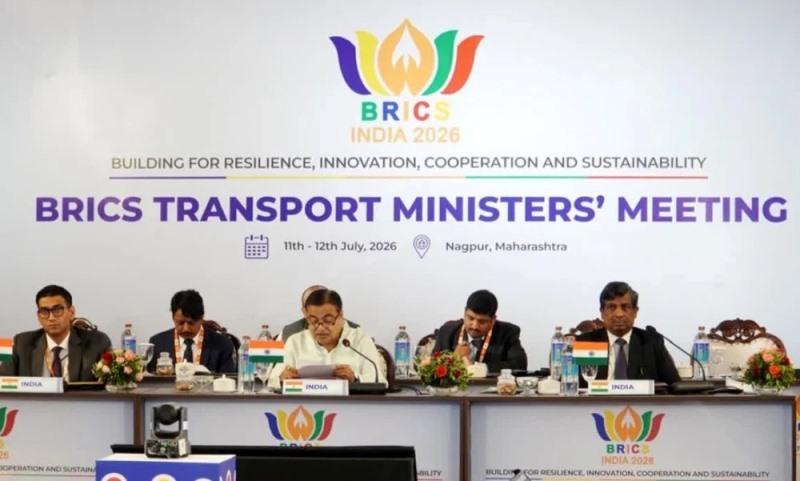
The BRICS Transport Working Group has unanimously adopted a resolution proposed by India’s Union Minister for Road Transport and Highways, Nitin Gadkari, aimed at accelerating the transition towards a carbon-neutral transport ecosystem across BRICS nations through the adoption of biofuels and other alternative energy sources.
The resolution, approved during the Third BRICS Transport Working Group Meeting held in Nagpur under India’s chairship, promotes the use of clean fuels across all modes of transport, including road, rail, maritime, and aviation. It also emphasizes enhanced collaboration among BRICS member countries in research, innovation, and technology sharing to support sustainable transport development.
Addressing the BRICS Transport Ministers’ Meeting, Gadkari highlighted the strategic role of BRICS nations, noting that the bloc represents nearly 40% of the world’s population, positioning it to lead the global transition towards sustainable mobility.
“BRICS member countries are uniquely placed to drive the development of environmentally sustainable transport systems through cooperation, innovation and shared commitment,” Gadkari said.
India Showcases Sustainable Infrastructure Initiatives
The minister outlined India’s significant achievements in infrastructure development, including the creation of the world’s second-largest road network, rapid expansion of railway and maritime infrastructure, and enhanced regional air connectivity.
He stressed that India’s infrastructure growth has been accompanied by a strong focus on environmental sustainability and innovation. Among the key initiatives highlighted were:
Utilisation of municipal waste, fly ash, steel slag, and end-of-life tyres in road construction.
Installation of bamboo crash barriers as sustainable road safety infrastructure.
Expansion of electric bus fleets and implementation of green urban mobility initiatives.
Introduction of cashless treatment facilities for road accident victims.
The success of the UDAN regional connectivity scheme in expanding air transport access.
PM Gati Shakti Driving Multimodal Connectivity
Gadkari said the PM Gati Shakti National Master Plan has transformed India’s infrastructure planning by integrating road, rail, ports, airports, and logistics infrastructure, resulting in lower logistics costs and faster project execution.
He also highlighted the success of the Hybrid Annuity Model (HAM) in attracting private investment into infrastructure projects and cited landmark developments including the Delhi-Dehradun Economic Corridor, Sonmarg Tunnel, and more than 10,000 km of greenfield expressways as examples of India’s infrastructure transformation.
Cooperation on Green Technologies
Calling for stronger collaboration within BRICS, Gadkari proposed deeper engagement in areas such as:
Green hydrogen technologies
Electric mobility
Digital transport systems
Sustainable multimodal infrastructure
Research and innovation partnerships
He also noted the rapid modernisation of Indian Railways, progress on the Mumbai-Ahmedabad High-Speed Rail Corridor, and the Maritime Amrit Kaal Vision 2047, under which green shipping has been identified as a key pillar for improving logistics efficiency and sustainability.
India has reaffirmed its commitment to achieving net-zero carbon emissions by 2070, supported by initiatives promoting electric vehicles, railway electrification, renewable energy, biofuels, and sustainable transport infrastructure.
The adoption of the India-led resolution is expected to strengthen cooperation among BRICS nations in advancing cleaner, more resilient, and future-ready transport systems while contributing to global climate goals.