
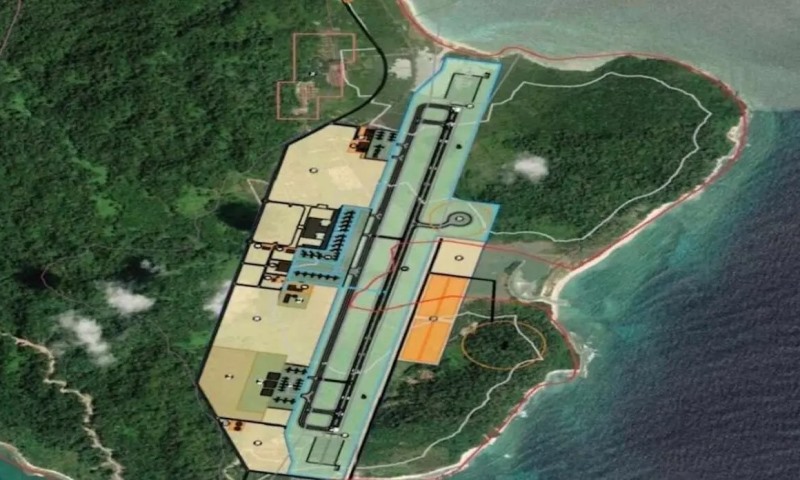
The ambitious Great Nicobar Islands (GNI) development project is set to emerge as a major strategic, economic and maritime hub for India while incorporating extensive environmental protection measures and safeguards for indigenous tribal communities, according to defence sources.
The Government of India has planned the holistic development of Great Nicobar through four interconnected projects: an International Container Transshipment Port (ICTP), a joint-use Greenfield airport and naval air station, a township, and a power plant. The project is designed to capitalize on the island’s strategic location near key international shipping routes while strengthening India’s defence posture in the Indian Ocean Region.
Located just 40 kilometres from the Six Degree Channel and close to the vital sea route linking the Gulf of Aden and the Malacca Strait, Great Nicobar occupies a critical position along one of the world’s busiest maritime corridors. Defence officials noted that nearly two-thirds of global oil shipments and half of the world’s container traffic pass through this region.
The project is expected to enhance India’s maritime surveillance, logistics support and operational capabilities in the southeastern Indian Ocean. It will also strengthen India’s role as a preferred security partner and first responder for humanitarian assistance, disaster relief and search-and-rescue operations under the government’s MAHASAGAR (Mutual and Holistic Advancement for Security and Growth Across Regions) vision.
A key component of the initiative is the proposed International Container Transshipment Port, situated approximately 40 nautical miles from the Malacca Strait. The facility is expected to advance India’s ambition of becoming a major transshipment hub and reduce dependence on foreign ports for cargo handling.
The Union Cabinet had approved the establishment of a Greenfield airport under the operational control of the Indian Navy. The airport is expected to significantly improve India’s maritime domain awareness and operational reach in the region. The Airports Authority of India has projected an initial passenger handling capacity of 1.35 million passengers per annum by 2040.
According to defence sources, multiple sites, including INS Baaz at Campbell Bay, were evaluated before Galathea Bay was selected. The INS Baaz expansion proposal was found to be constrained by terrain, environmental concerns, limited expansion possibilities and potential impacts on local settlements and wildlife.
Officials emphasized that environmental assessments were conducted in compliance with the Environment Impact Assessment (EIA) Notification 2006 and Coastal Regulation Zone (CRZ) Notification 2019. The studies involved leading institutions including the Zoological Survey of India (ZSI), Wildlife Institute of India (WII) and Salim Ali Centre for Ornithology and Natural History (SACON).
The assessment found that only 166.1 square kilometres have been earmarked for development, while 81.74 per cent of the island will continue to remain under forests, national parks, biosphere reserves and tribal conservation areas. Although around 130.75 square kilometres of forest land will be diverted, officials said more than half of this area will remain green with no tree felling planned.
To support long-term ecological protection, a dedicated conservation programme worth ₹2,220.41 crore over 30 years has been proposed. The programme will focus on the protection of wildlife and ecosystems, including Leatherback turtles, Nicobar megapodes, crocodiles, coral reefs and mangroves.
The project has also received environmental clearances that have withstood scrutiny before the National Green Tribunal (NGT), which found no grounds to interfere after noting the safeguards and mitigation measures incorporated into the plan.
Regarding tribal welfare, defence sources stated that no physical displacement of indigenous communities is proposed. The Environmental Impact Assessment recorded that while 73.07 square kilometres were denotified from the Tribal Reserve, an additional 76.98 square kilometres have been newly notified, resulting in a net increase of 3.91 square kilometres in tribal reserve area.
Consultations were conducted with tribal welfare authorities, the Andaman Adim Janjati Vikas Samiti (AAJVS), the Nicobari Tribal Council and the Ministry of Tribal Affairs, in accordance with the Forest Rights Act, 2006.
Apart from its strategic and economic significance, the project is expected to generate substantial employment opportunities. Defence sources estimate that more than one lakh direct jobs could be created, with additional indirect employment arising from supporting industries and services.
Officials said the Great Nicobar project aims to simultaneously strengthen India’s national security, expand maritime trade infrastructure, promote tourism and ensure environmental conservation and tribal welfare through a balanced development approach.