
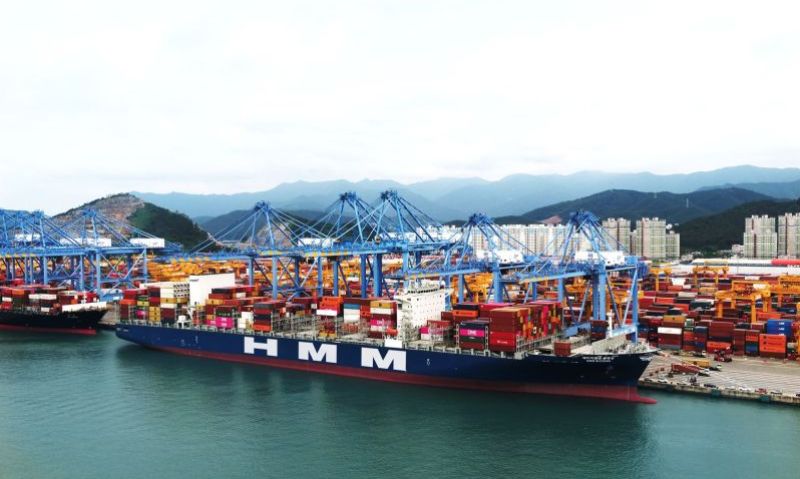
South Korea’s flagship carrier, HMM, plans to install onboard carbon capture and storage (OCCS) systems on ships too young to be scrapped and not practical to convert to run on methanol or LNG.
At a recent seminar on eco-friendly shipping, HMM director Kim Min-kang said: “Even if new ships equipped with dual-fuel engines [for fuels] such as LNG or methanol are released on the market in four to five years, existing ships (that are not designed to reduce carbon emissions) will still account for 60%-70% of the fleet. So what to do with these ships is a huge problem.
“Considering the scale of investment, such as the remaining period of the ships’ lifespan, retrofitting is not realistic.”
Mr Kim suggested that OCCS systems, which collect carbon dioxide generated from vessel operations and store it in liquid form, are viable solutions to help control greenhouse gas emissions.
In July, HMM became the first South Korean shipowner to experiment with OCCS, testing a system on the 2,200 teu HMM Mongla, assigned to its intra-Asia service. The OCCS system was jointly developed by Samsung Heavy Industries, compatriot marine equipment maker Panasia and the Korean Register of Shipping.
While other shipowners have fixed wind propulsion devices, such as rotor sails, to vessels, Mr Kim claimed these devices were unsuitable for containerships and tankers.
He said: “In theory, OCCS devices can capture 100% of carbon dioxide, but since the process consumes additional energy, it is currently known to capture 60%-70% of CO2 generated. How to process the captured carbon will be the final obstacle to commercialisation.”
Captured carbon dioxide can be buried or used for welding in shipyards. While burial is the most commonly studied solution, there is no means to transport the carbon dioxide to the burial site. Due to this, HMM is looking to sign agreements with shipyards to provide captured carbon as a shielding gas for arc welding.
HMM’s spokesperson said: “HMM aims to have low-carbon vessels forming 40% of our fleet by 2030, reflecting our commitment to environmental sustainability. We’re planning several options, such as using biofuels and installing OCCS systems.”