
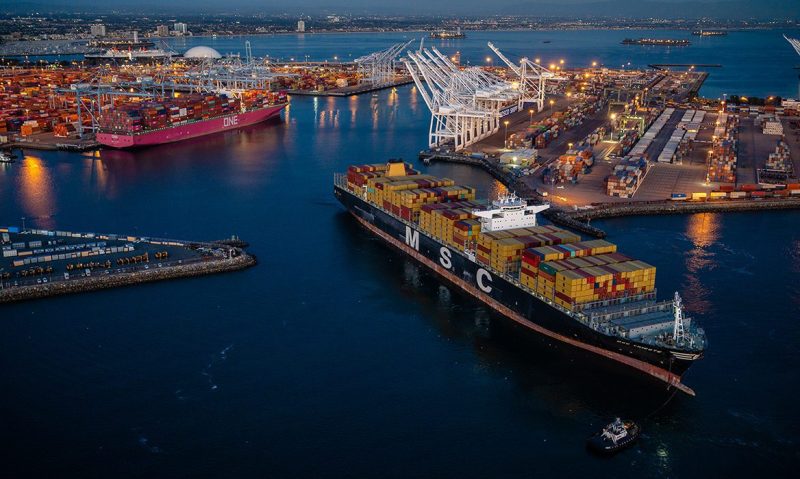
The Los Angeles Board of Harbor Commissioners has approved a new cooperative agreement with South Coast AQMD and the Port of Long Beach.
The deal accelerates the rollout of zero-emission technology and infrastructure across both ports.
The agreement covers all major emission sources, including cargo handling equipment, harbour craft, trucks, trains, and ocean-going vessels.
Mayor Karen Bass said: “The passage of the Cooperative Agreement is just one way we are continuing our historic efforts to create a cleaner, more sustainable city, including the Port of Los Angeles.
“By working together with our partners at South Coast AQMD and the Port of Long Beach we will continue to build upon this moment, achieving our shared goal of cleaner air, healthier communities, and a more climate resilient future for all.”
The agreement, previously approved by South Coast AQMD and the Port of Long Beach, sets out a three-phase plan for both ports to develop comprehensive zero-emission infrastructure strategies.
A draft plan is due by May 2027, with fully approved plans across all emission categories required by the end of 2029.
Los Angeles City Council member and South Coast AQMD Board Member, Nithya Raman, stated: “This Cooperative Agreement represents an important step toward creating clean, breathable air for our local communities and I am committed to making sure we hold ourselves accountable to the proposals set forth. Continuing a decade of inaction on this issue is simply not an option, and I am grateful to everyone who participated in the conversation to move this zero-emission legislation forward.”
Port of Los Angeles Executive Director Gene Seroka said: “We look forward to this new era of collaboration between our ports and the South Coast AQMD as we work together toward a zero-emission future. This action represents a balanced, results-driven approach to developing the infrastructure necessary to continue reducing emissions at the San Pedro Bay ports.”
Progress on the ports’ infrastructure plans will be verified by South Coast AQMD through annual reports and regular updates to its Governing Board. Penalties for noncompliance range from $50,000 to $200,000 per default, with fees earmarked for projects benefiting nearby communities.
The agreement builds on the ports’ Clean Air Action Plan (CAAP), a voluntary program launched in 2006.
Since its introduction, the Port of Los Angeles has cut diesel particulate matter (DPM) by 90 per cent, sulfur oxides (SOx) by 98 per cent, and nitrogen oxides (NOx) by 73 per cent, with container-based emissions down 93 per cent, 99 per cent, and 81 per cent respectively.
Both ports continue working with South Coast AQMD to expand CAAP measures targeting oceangoing vessels, the largest source of port emissions. The board is expected to review these “CAAP-Plus” initiatives in Spring 2026.
In October, the Port of Los Angeles reported robust throughput, handling 848,431 TEUs despite ongoing trade fluctuations and uncertainties that have marked this year’s shipping landscape.