
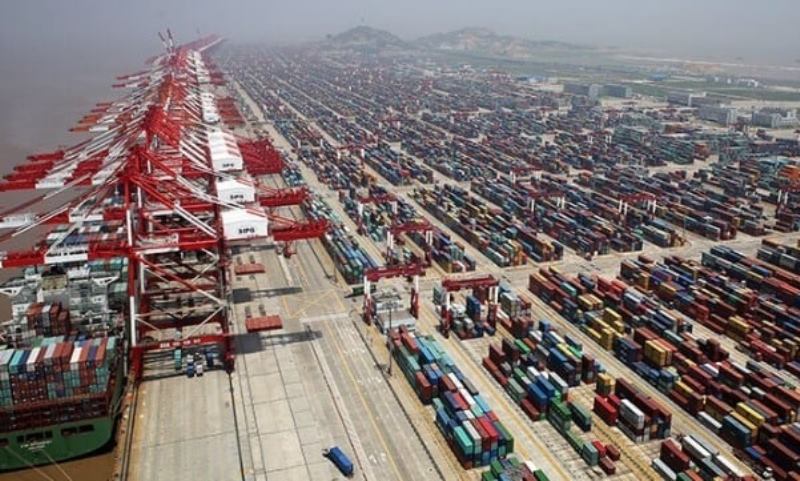
China’s leading ports entered the final quarter of 2025 on a strong footing, with Shanghai surpassing the 40 million TEU mark despite persistent uncertainty in global logistics networks.
Major coastal hubs, led by Shanghai and Ningbo-Zhoushan, continued to post strong gains.
Shanghai, the world’s busiest port, handled 4.83 million TEU in September, marking a 13.6 per cent month-on-month jump and lifting its year-to-date throughput to 41.5 million TEU, 6.2 per cent higher than a year earlier.
Close behind, Ningbo-Zhoushan maintained a powerful upward trajectory, processing 3.83 million TEU in September — a 12.7 per cent monthly increase — for a cumulative total of 32.5 million TEU, up 9.9 per cent year-on-year.
Elsewhere, other Chinese ports recorded broadly positive results. Qingdao rose 6.5 per cent month-on-month to 2.8 million TEU, while Tianjin grew 3.3 per cent to 2.22 million TEU.
Shenzhen, after a busy summer peak, saw volumes cool 12.4 per cent to 2.63 million TEU, though still 5.4 per cent above last year’s levels.
Guangzhou handled 2.02 million TEU, easing 5.6 per cent month-on-month, yet maintaining a 5 per cent year-on-year gain.
Smaller but fast-rising players continued to impress. Beibu Gulf posted a 12 per cent monthly surge to 840,000 TEU, underscoring the growing role of Guangxi’s trade corridors with ASEAN markets.
Yingkou also advanced 11.4 per cent, and Xiamen strengthened by 4.9 per cent, while Dalian saw modest growth of 2.2 per cent.
Consistent double-digit growth at key terminals underlines the country’s enduring dominance in maritime throughput and its adaptability in a shifting global trade environment.