
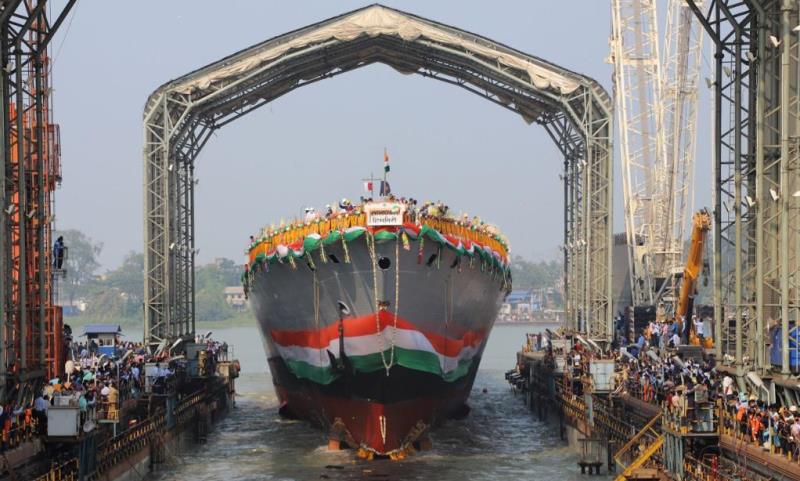
Pressure is mounting on the Finance Ministry to revise the eligibility criteria notified on September 19 for granting infrastructure status to ships, with local shipbuilders now seeking the intervention of Sanjeev Sanyal, economist and member of the Prime Minister’s Economic Advisory Council, to amend the policy.
While the move to extend infrastructure status to shipping has been hailed as a breakthrough, shipbuilders and coastal ship owners argue that the exclusion of smaller coastal vessels will stall India’s ambition to become a global shipbuilding hub.
Under the notification, Indian-owned and flagged commercial ships of 10,000 gross tonnage (GT) and above, or Indian-built, owned and flagged commercial ships of 1,500 GT or more, will be eligible for infrastructure status. However, this leaves out more than 500 smaller coastal vessels such as tugs, dredgers, and offshore supply vessels — a majority of which are vital for coastal trade and local industry.
The Shipyards Association of India (SAI) has warned that the Finance Ministry’s framework “deviated” from the consensus reached with industry stakeholders and ignored the recommendation of the Ministry of Ports, Shipping and Waterways and the Directorate General of Shipping, which had proposed a benchmark of 24 metres in length or 500 GT.
“It is rather surprising and disappointing that the Finance Ministry has totally disregarded the recommendation of the nodal ministry. The exclusion of smaller vessels will likely hinder the growth of MSME shipyards which are crucial for achieving the Make in India goal,” said Sanjiv Walia, CEO of SAI, in a letter to Sanyal.
Officials in the shipping ministry, however, defended the criteria, arguing that the intent was to support larger capital-intensive projects. “The idea of giving infrastructure status is to support larger capex,” said R. Lakshmanan, Joint Secretary, Ministry of Ports, Shipping and Waterways. “If a vessel is built in India, it covers anything above 1,500 GT. So, it practically covers all the coastal shipping vessels.”
Industry stakeholders remain unconvinced. They argue that the criteria not only deprive small coastal shipowners of cheaper and long-term funding options but also jeopardize the future of MSME shipyards already struggling to compete globally, with costs 24–26% higher than China, South Korea, and Japan.
“The eligibility criteria contradict the government’s own initiatives such as the Maritime India Vision 2030 and the Maritime Amrit Kaal Vision 2047. Without policy support, coastal shipbuilding will remain dependent on older foreign vessels, undermining India’s strategic and economic interests,” SAI said.
Calling for urgent revision, the association stressed that setting a fair threshold of 24 metres or 500 GT would help MSME yards thrive, promote domestic shipping, and align with the government’s Make in India vision.