
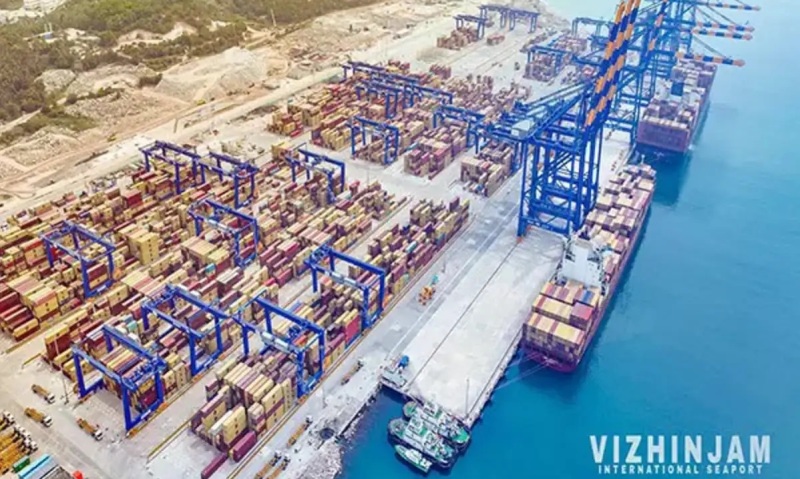
Prime Minister Narendra Modi dedicated the country’s first deepwater transhipment port—the Vizhinjam International Deepwater Multipurpose Seaport—in Kerala to the nation on Friday, in what is being viewed as the first step in making India a global shipping hub.
The Vizhinjam transhipment port project was conceptualised in 1991 but navigated through numerous legal, environmental, logistical, and financial hurdles.
The Kerala government holds a majority stake in the port built under the public-private-partnership mode at the cost of ₹8,900 crore.
The port, developed by Adani Ports and Special Economic Zone Ltd. (APSEZ), is expected to transform India’s role in international trade and shipping and could save $220 million in revenue annually.
What is a deepwater transhipment port?
A transhipment port has terminals where cargo containers are shifted from one vessel to another before the ships reach their destinations. These ports are used to process large amounts of international cargo. Until now, India had to rely on big foreign ports like Colombo for this.
The absence of such a port infrastructure in India meant longer transit times and delays for traders.
How will the seaport help India save millions?
Since there was no deepwater transhipment port in the country, 75 per cent of India’s transhipment cargo used to come through foreign ports like Colombo in Sri Lanka, Singapore, and Jebel Ali in the UAE, leading to longer transit periods and delays for domestic traders, costing them an additional $80 to $100 per container.
India can now generate an additional $220 million a year by serving its cargo.
Apart from money, the capacity to handle transhipment cargo would insulate India’s supply chains from potential geopolitical shocks.
Located just 10 nautical miles from the international shipping route that connects Europe, the Persian Gulf, and the Far East, Vizhinjam enjoys inherent locational advantages.
Its proximity to the East-West axis provides easy access without deviation for large vessels that form the lifeline of ocean commerce.
As a result, India can service big cargo vessels with a capacity of upwards of 20,000 containers. The location has minimal sand movement along the coast, thus reducing maintenance costs.
Gifted by nature with a deep draft of 18 metre close to shore that requires no capital dredging, Vizhinjam can leverage its natural depth to host even ultra-large next-gen container ships requiring 20 metre+ drafts.
The Prime Minister said that the capacity of this transhipment hub will triple in the coming years, enabling the smooth arrival of some of the world’s largest cargo ships.
“Vizhinjam will bring economic stability to Kerala and India,” the PM said.