
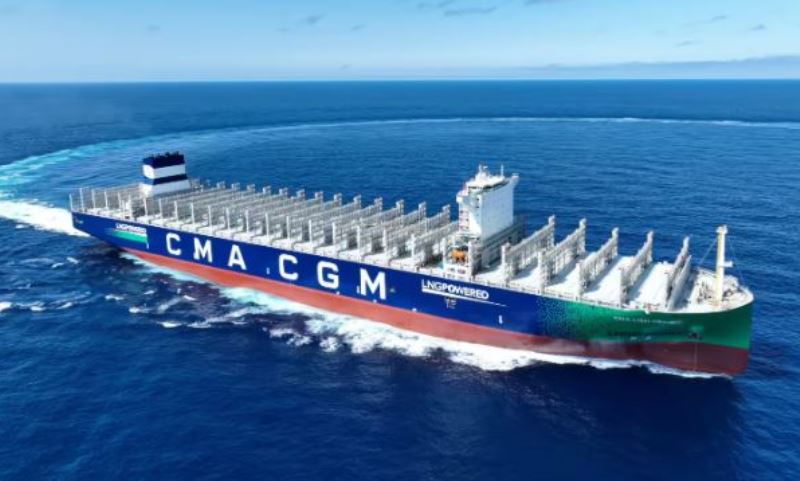
Rodolphe Saadé-led CMA CGM, the world’s third-largest container carrier, will sign a firm contract with state-owned Cochin Shipyard Ltd (CSL) on February 18, 2026, for constructing six LNG-powered container vessels in a deal valued at approximately $300 million, marking a defining milestone for India’s shipbuilding industry.
The agreement will be formalised in the national capital in the presence of Union Minister of Ports, Shipping and Waterways Sarbananda Sonowal and CSL Chairman and Managing Director Jose V J. CMA CGM Chairman and Chief Executive Officer Rodolphe Saadé will personally attend the signing ceremony, along with representatives from the office of French President Emmanuel Macron, underlining the strategic importance of the order for both India and France.
Each of the six container vessels will have a capacity of 1,700 twenty-foot equivalent units (TEUs) and will be powered by liquefied natural gas (LNG), in line with CMA CGM’s decarbonisation roadmap for the global shipping industry. The firm contract follows a Letter of Intent signed between CMA CGM and CSL in October 2025, after which both sides fine-tuned the order details while awaiting clarity on the Shipbuilding Financial Assistance (SBFA) scheme issued by the Ministry of Ports, Shipping and Waterways in late December.
Under the SBFA scheme, CSL will receive financial assistance of 15 per cent on the first ₹100 crore and 25 per cent on the remaining value for each vessel, as the ships fall under the specialised category eligible for state support.
The order is being described as historic as it marks the first time a global mainline container shipping operator has placed a container shipbuilding order in India. Industry stakeholders see it as a breakthrough moment for domestic shipyards seeking integration into the global commercial shipbuilding supply chain.
India is currently ranked 16th globally in shipbuilding with less than one per cent market share, but aims to break into the top 10 by 2030 and the top five by 2047. The container ship order aligns with the government’s ₹69,725 crore maritime development package approved last year to strengthen the country’s shipbuilding ecosystem.
For CSL, which has previously built India’s first indigenous aircraft carrier and several specialised vessels, the deal represents a major commercial leap. Its recent technical collaboration with South Korea’s HD Korea Shipbuilding & Offshore Engineering is understood to have enhanced confidence in its capability to execute container ship projects.
The development also follows Prime Minister Narendra Modi’s visit to CMA CGM’s headquarters in Marseille last year, during which Saadé committed to expanding the Group’s footprint in India. In recent months, CMA CGM has reflagged four container vessels under the Indian flag and confirmed that the six ships to be built at CSL will also sail under the Indian registry.
Saadé has previously stated that the Group views India as a strategic alternative for building smaller LNG-propelled container ships and expressed enthusiasm over the speed with which the project progressed from discussions to firm order.
Industry executives believe the order will help CSL enter the global container shipbuilding supply chain, improve vendor access, build credibility with international engine manufacturers and technology partners, and catalyse the development of a domestic marine equipment ecosystem. The deal is also expected to enhance scale and competitiveness for Indian shipyards, potentially paving the way for further orders from major global fleet owners.