
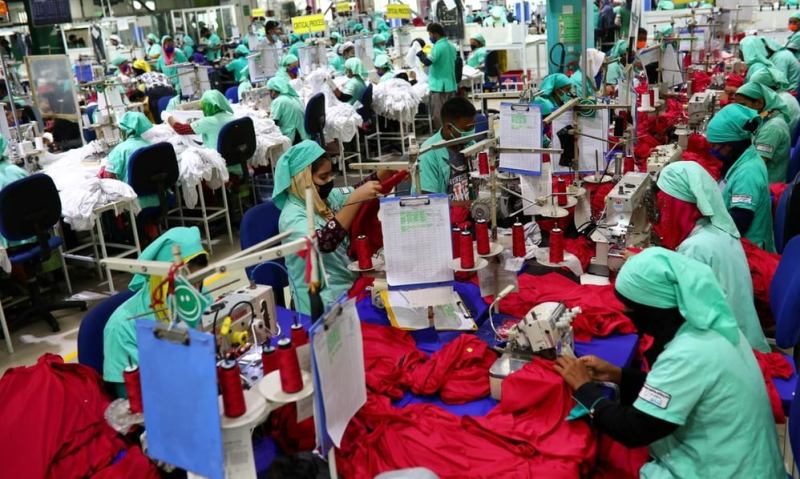
India’s knitwear hub, Tiruppur, achieved its highest-ever export performance in 2025-26, with knitwear exports reaching ₹46,000 crore, marking a 3% increase over ₹44,747 crore recorded in FY25. The milestone was achieved despite uncertainties arising from additional US tariffs and geopolitical tensions in West Asia.
The record export figures were announced by the Tiruppur Exporters Association (TEA) during an industry event attended by Union Minister of Textiles Giriraj Singh, who reaffirmed the Central Government’s commitment to supporting the region’s textile industry. TEA also unveiled an ambitious target of achieving ₹1 trillion in exports by 2030.
Addressing the gathering, Giriraj Singh said the Centre aims to increase India’s textile exports from the current US$38 billion to US$100 billion by 2030, with Tiruppur expected to play a pivotal role in achieving this goal.
TEA President K. M. Subramanian said Tiruppur contributed nearly 60% of India’s total knitwear exports during FY26 while providing employment to more than one million people. He attributed the export growth to a healthy order pipeline and the depreciation of the Indian rupee against the US dollar, which improved export competitiveness. The average exchange rate during FY26 stood at around ₹85.6-86 per US dollar, compared with ₹83.1-83.3 in the previous fiscal.
To support the industry’s long-term growth, TEA submitted a series of policy recommendations to the Union Minister, including the establishment of worker accommodation and hostel facilities, zero import duty on cotton, extension of the Rebate of State and Central Taxes and Levies (RoSCTL) scheme, and early implementation of the proposed Textile Expansion and Employment (TEEM) scheme.
Responding to the industry’s requests, Giriraj Singh assured that the Centre would extend full support for developing hostels for women workers, creating new industrial clusters, and promoting advanced manufacturing technologies. He said India’s economic growth, improved infrastructure and expanding network of Free Trade Agreements (FTAs) are opening significant opportunities for the textile sector.
The Minister also commended Tiruppur’s gradual transition from a predominantly cotton-based manufacturing base to greater production of blended and man-made fibre (MMF) garments, describing the shift as essential for enhancing global competitiveness. He encouraged the industry to adopt sustainable manufacturing practices and environmentally friendly technologies, with the sector targeting a future production mix of 50% cotton and 50% MMF-based products.
A. Sakthivel, Chairman of the Apparel Export Promotion Council (AEPC) and Honorary Chairman of TEA, highlighted the Ministry of Textiles’ ongoing initiatives to strengthen the sector, including the establishment of textile parks under the PM MITRA scheme and increased focus on MMF garment production and exports. He also called for the early implementation of the Affordable Housing Scheme to address the accommodation needs of textile workers.
Sakthivel noted that India’s trade agreements with 38 countries, including the India-UK Free Trade Agreement, which is set to come into effect on July 15, will significantly expand market access for Indian textile exporters. He further sought a 50% capital subsidy for the MMF processing sector, simplified import procedures, and the establishment of a dedicated green processing centre in Tiruppur.
As part of India’s target of achieving US$100 billion in textile exports by 2030, Tamil Nadu has been assigned an export target of US$21 billion, with Tiruppur expected to contribute US$11.5 billion. The Tamil Nadu Government has also set a target of producing ₹1,000 crore worth of technical textiles and creating 5,000 specialised jobs by 2031, while allocating ₹1,250 crore over the next five years for the construction of hostels for women workers through the Social Welfare Department.