
India and Russia on Friday moved to deepen their economic partnership by signing a Vision 2030 roadmap focused on trade expansion, strategic cooperation and new connectivity initiatives. After bilateral talks in New Delhi, Prime Minister Narendra Modi and President Vladimir Putin emphasised the need to strengthen supply chains and develop new routes amid global economic turbulence and Western tariff pressures.
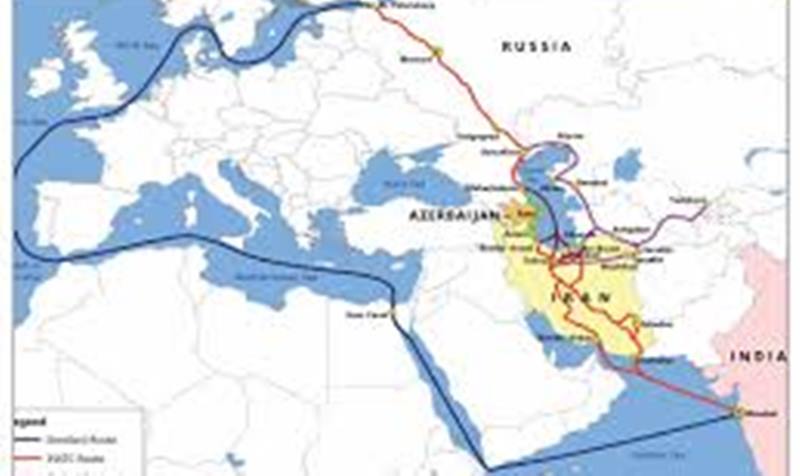
Putin highlighted nuclear energy collaboration and the shift to national currency settlements, while reiterating Moscow’s intention to expand the International North–South Transport Corridor (INSTC) — a sprawling connectivity network designed to link Russia and Belarus with the Indian Ocean.
“We are working with our Indian partners to build new international transport routes, including the project to create North-South transport from Russia or Belarus to the Indian Ocean coast.”, Putin said, adding that an expanded INSTC and Northern Sea Route would offer “major opportunities for bilateral trade.”
Why Moscow is prioritising the INSTC now
For Russia, the INSTC is increasingly tied to its efforts to reorient trade away from Europe and toward Asia, West Asia and Africa. According to Aleksei Zakharov, Fellow at the Observer Research Foundation (ORF), the project is central to Moscow’s search for stable export pathways.
“Russia is exploring new avenues and new connectivity projects with the countries of the Global South,” he said, adding that the INSTC is intended to support “sustainable shipments of its goods — agricultural products, raw materials, resources.”
Zakharov stresses that Moscow sees the corridor as a strategic complement to existing Eurasian routes: “It’s a vertical corridor, because in Eurasia many projects go east to west. This one goes north to south, and it adds to connectivity in the region.”
Crucially, India is not the only target market: once cargo reaches Iran’s Bandar Abbas port, “Russian products can be delivered to the countries of the Gulf, to East Africa and to Southeast Asia,” he said.
Three corridor branches — and why they matter
Although envisioned in 2000, the INSTC has expanded into three major branches, each at a different stage of development.
Zakharov notes that the eastern branch—running through Kazakhstan and Turkmenistan into Iran—has been the most active recently: “This branch has been more dynamic in terms of shipments, and the timing of delivery has been reduced. So there have been positive developments.”
The western branch, running through Azerbaijan and Iran, remains incomplete. Russia has financed work on Iran’s missing 160 km rail link, which Zakharov describes as “one part of the effort,” but he also highlights a second: “Russia is exploring a new railroad that will prevent unnecessary transshipment of goods, which takes time and complicates logistics.”
He adds that several “technical bottlenecks make delivery slower and less predictable,” which is why Russia is undertaking multiple projects simultaneously.
While the INSTC is technically operational, Zakharov stresses its limitations: “Some shipments are there, so the corridor is partially functioning. But much remains to be smoothed out.”
Despite assumptions that Russia’s urgency stems from Western sanctions, Zakharov says such interpretations are exaggerated. “I don’t think we can make much out of this mention,” he said, noting that the INSTC has been consistently referenced “in official statements and bilateral documents since 2000.”
He argues that its revival is not a reactive move: “It’s just a traditional thing. The project is quite old. It has always been acknowledged as an important connectivity project by both sides.”
Moreover, he points out that maritime shipping continues to carry most India–Russia commerce: “It has not emerged as a game changer. The largest part of transport connectivity is still conducted by maritime shipments.”
That stability is why existing trade has not been disrupted: “Sanctions have not prevented these shipments from sustaining,” he said.
Where India fits into the picture
India remains Russia’s most significant partner in South Asia and a rapidly growing trade destination — which gives Moscow an incentive to highlight the INSTC during high-level visits.
Zakharov notes that Russia sees India as central to the project’s long-term viability: “India is the largest market and now a big trading partner for Russia. It is a very important destination.” Russian delegations regularly pitch the INSTC in New Delhi as the future backbone of bilateral logistics.
For India, the corridor offers shorter transit times, cheaper logistics and potential gateways to Central Asian and Eurasian markets. As New Delhi advances a prospective Free Trade Agreement with the Eurasian Economic Union, such corridors may become increasingly relevant.
Outlook: High potential, but slow maturation
Zakharov describes the INSTC as a “complementary logistical mechanism” that could, over time, enhance bilateral trade — but he cautions against overstating its current importance. “As of now, it does not play a crucial role,” he said. “It has much potential, but it will require sustained investment and coordination.”
In the short term, maritime shipping will remain dominant. But in the medium term, improved land corridors could help India and Russia diversify their trade routes as they operationalise Vision 2030.