
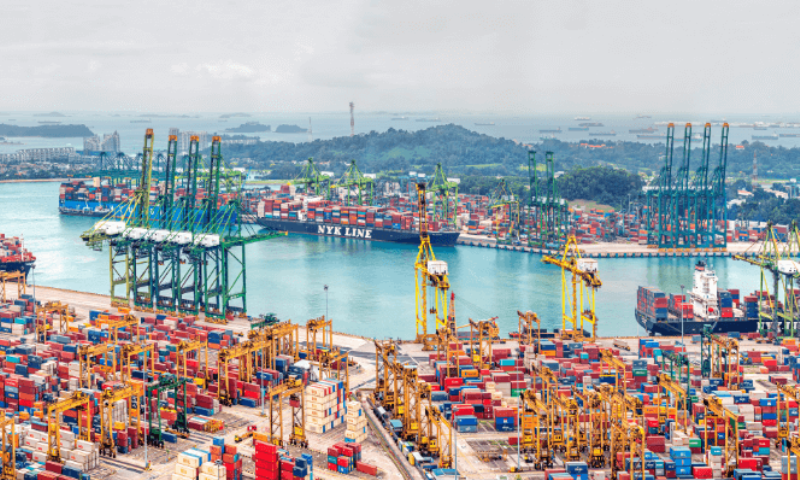
Despite ongoing global geopolitical tensions and shifting shipping alliances, Singapore reaffirmed its status as the world’s second-largest container port and the leading global bunkering hub in 2025.
According to figures released by the Maritime & Port Authority of Singapore (MPA), the Port of Singapore handled 44.66 million TEUs in 2025, representing an 8.6 percent year-on-year increase. The data was revealed by Senior Minister of State for Law and Transport Murali Pillai at the Singapore Maritime Foundation’s New Year Conversations 2026, held on Tuesday evening.
Singapore retained its long-standing second-place ranking behind Shanghai, demonstrating resilience in a year marked by major realignments in global liner shipping networks. One of the most significant changes was the launch of the Gemini Cooperation between Maersk and Hapag-Lloyd, which has concentrated services around key hubs where the partners have terminal interests.
In Southeast Asia, this strategy has favoured Port of Tanjung Pelepas (PTP) in Malaysia, where Maersk’s APM Terminals holds a 30 percent stake. The shift raised concerns over a potential diversion of Hapag-Lloyd volumes away from Singapore. However, Singapore’s performance remained robust, even as PTP recorded a strong 13.8 percent growth, handling 14.03 million TEUs in 2025.
Singapore also strengthened its position as the world’s largest bunkering port, with total bunker sales rising 3.4 percent year-on-year to 56.77 million tonnes. Sales of alternative fuels saw particularly strong momentum, increasing to 1.95 million tonnes from 1.35 million tonnes in 2024, reflecting the industry’s accelerating transition toward cleaner marine fuels.
Further underlining this push, the MPA on 14 January launched a tender for additional LNG bunkering licences, covering bio-methane and e-methane. Under the tender conditions, licence holders will be required to own or charter an LNG bunker vessel registered under the Singapore Registry of Ships for the full duration of the licence.
The tender is open to both new applicants and existing LNG bunkering licensees, reinforcing Singapore’s ambition to remain at the forefront of sustainable maritime fuel supply.
Together, the strong container throughput growth and continued dominance in bunkering highlight Singapore’s ability to maintain its global maritime leadership amid an increasingly complex and competitive operating environment.