
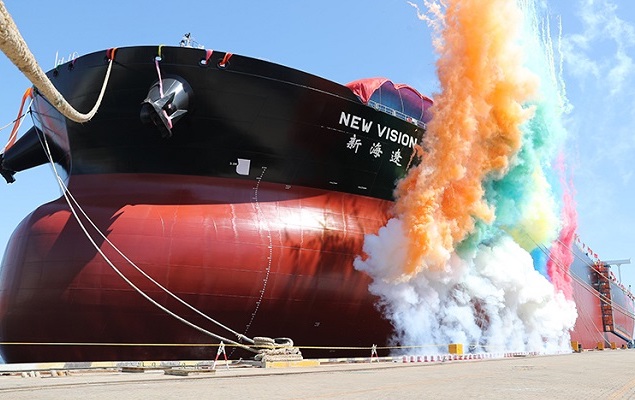
Switching tankers to carry clean products rather than crude is an expensive process. However, today’s soaring product tanker rates are seeing more and more VLCC and suezmax owners eye this conversion trade, and not just on maiden voyages.
Providing data on both the costs involved and the attainable rates possible, New York broker Poten & Partners has illustrated why more vessels are undergoing conversion therapy.
If the entire voyage, including about 30 days for clean-up of a VLCC’s tanks, takes around 90 days, Poten estimates the hire at $4m or $45,000 a day. Adding to that the costs for fuel and chemicals, de-slopping charges, the additional manpower cost, as well as bunkers and lightering costs would bring the total cost of the voyage to $7m, according to Poten estimates.
However, the savings on freight are so high today that it is worth it. In today’s market, moving a 90,000 metric ton cargo of diesel on an LR2 from the Arabian Gulf to the UK Continent costs $4.4m, or $49 per ton. This is almost double the cost of the much larger VLCC, which is $7m for 280,000 tons, or $25 a ton, Poten data suggests.
This freight arbitrage will likely continue, Poten predicted, until the growing number of cleaned up crude tankers tips the balance back in favour of the dedicated product fleet and/or a pickup in oil movements pulls the crude fleet back in their core trades.
In related tanker segment shift news, analysts at Gibson, another tanker broker, have been looking at the “dying” LR1/panamax sector where just nine vessels were ordered between 2016 and 2022.
Demand for this niche ship type has faced “headwinds”, Gibson noted in its latest weekly tanker report with clean LR1 tonne miles down 2.5% over the past five years and dirty panamax trade seeing significant 42% declines. By contrast, clean LR2s have benefitted from a near 29% increase and aframaxes have witnessed an 18% jump in tonne miles.
“With threats from the Aframax, LR2 and MR sector, it is uncertain what level of investment is required to meet future demand,” Gibson suggested.
Explaining why LR1s are fading from view, Gibson noted that the expansion of refining capacity east of Suez and corresponding contraction in the West has tended to favour LR2s, which typically offer better economies of scale.
Changes to vacuum gasoil and fuel oil flows have also shifted demand away from panamaxes in recent years, whilst the expanded Panama Canal has meant aframaxes are more competitive in reaching the US west coast.