
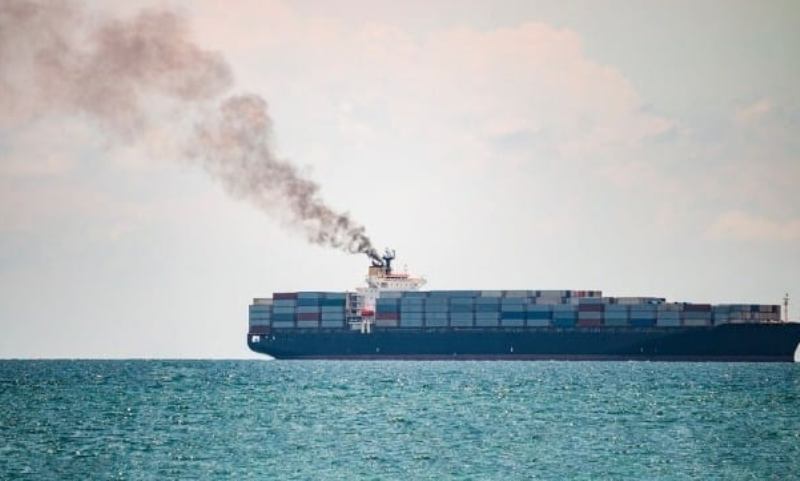
The world’s leading maritime nations are convening in London this week to consider historic regulations aimed at reducing greenhouse gas emissions from international shipping, potentially marking the first global carbon fee for the sector.
If adopted, the Net-zero Framework would impose fees on emissions from ships running on fossil fuels, primarily heavy fuel oil, which currently powers most vessels and contributes significantly to carbon dioxide and other pollutants. The International Maritime Organization (IMO) is hosting the meeting at its London headquarters, which runs through Friday.
The regulations, developed in consultation with IMO member states, establish a tiered compliance system for greenhouse gas intensity in marine fuels. Ships exceeding allowable limits would pay fees starting at $380 per ton of CO₂ equivalent to meet base compliance, with additional penalties of $100 per ton for failing to meet more stringent targets. Ships emitting below required thresholds would receive credits, which can be sold to higher-emission vessels. Annual revenue from the program is projected at $11–13 billion, earmarked for funding green shipping technologies, supporting developing nations, and rewarding low-emission vessels.
“This is a major win for the climate, public health, and marine life,” said Delaine McCullough, shipping program director at the Ocean Conservancy. “For too long, ships have relied on crude, dirty oil. This agreement shows that legally binding climate action is possible.”
Shipping emissions have grown to approximately 3% of global totals over the past decade, driven by increased trade and the fuel-intensive nature of long-distance shipping. The IMO has committed to achieving net-zero emissions in the sector by 2050, promoting alternative fuels, electricity, carbon capture, wind propulsion, and other energy efficiency measures.
The regulations would apply to large oceangoing ships over 5,000 gross tonnage, which account for 85% of international shipping emissions, with penalties coming into effect in 2028 and the regulations entering force in 2027.
While the proposal has gained broad support, the Trump administration has opposed it, threatening retaliatory measures, setting up a potential clash at the meeting. Environmental groups and industry bodies, including the International Chamber of Shipping, representing more than 80% of the world’s merchant fleet, are advocating for adoption.
Experts have also voiced concerns over reliance on biofuels produced from food crops, which could strain agricultural production and contribute to deforestation. Alternative fuels such as green ammonia and methanol are expected to play a larger role in the long-term transition.
“Failure to adopt these regulations would delay decarbonization and allow shipping to continue contributing significantly to the climate crisis,” warned John Maggs of the Clean Shipping Coalition.
As nations gather in London, the eyes of the maritime and environmental communities are on the IMO, awaiting what could be a landmark decision for global shipping and climate action.