
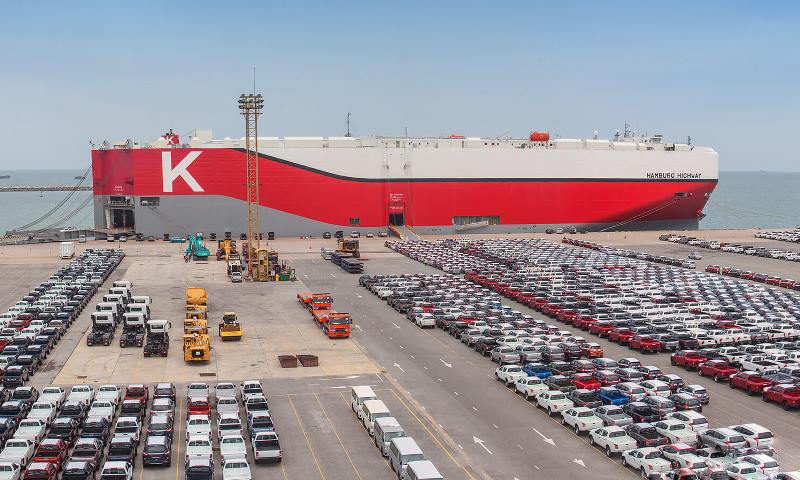
The US administration confirmed yesterday that it will go forward with the implementation of a 25% tariff on all foreign-built cars, something that is expected to add greater pressure to car carrier rates which have been coming off multi-year highs in recent months.
US president Donald Trump said the latest tariffs would come into effect on April 2, with charges on businesses importing vehicles starting the next day. Charges on auto parts are set to start in May or later.
Fredrik Dybwad, an equity researcher with Fearnleys Securities, said: “Car sales have already been struggling and have seen flattish sales growth the recent months, and the tariff will further add pressure to this. Near half of all cars sold in the US last year were imported, and it is quite clear for us that a 25% cost increase for importers will pressure car sales in the country further. All else equal, we expect car volumes going into the US to come down, negatively affecting seaborne volumes and thus also car carrier earnings.”
According to data from Skandinaviska Enskilda Banken (SEB), looking at the seaborne car trade last year, South Korea and Japan exported around 1.5m and 1.3m cars to the US, respectively. The EU exported around 0.9m cars, while others stood at around 0.2m to 0.3m cars, excluding Mexico and Canada. The total seaborne car trade reached around 24.5m cars last year, while the deepsea car trade reached around 15m cars.
“This implies that US imports – excluding Mexico and Canada – accounted for around 16% of global seaborne car trade and around 26% of the global deepsea car trade,” Jon Nikolai Skåland, an equity researcher at SEB, said. “Though, with Korea and Japan accounting for the majority of US deepsea imports, the car-mile impact is higher.”
By assuming a 25% reduction to these volumes following the 25% tariffs, the impact on global seaborne and deepsea trade would be a reduction of around 4-7%, respectively, according to Skåland.
“We view this as a negative for roro operators, potentially weakening the market balance and hold risk to the companies’ contract backlogs,” Skåland said.
“The car carrier market has weakened after the extraordinarily strong period across 2022-24, with fleet growth accelerating and demand growth cooling,” Clarksons Research noted in an update published on Friday prior to Trump’s latest tariff bombshell.
Following years of limited investment, cash-rich car carrier owners have embarked on a huge fleet renewal campaign with the sector now having one of the highest orderbook-to-extent ratios, a heavy delivery schedule coming this year and next.