
Kazakhstan’s recent declaration of readiness to participate in the proposed Trump Route for International Peace and Prosperity (TRIPP) corridor marks a significant development in the evolving landscape of Eurasian trade and transport connectivity. More than a diplomatic endorsement of regional infrastructure, Astana’s move highlights its ambition to play a central role in shaping future east-west logistics networks linking Central Asia, the South Caucasus, Türkiye, and Europe.
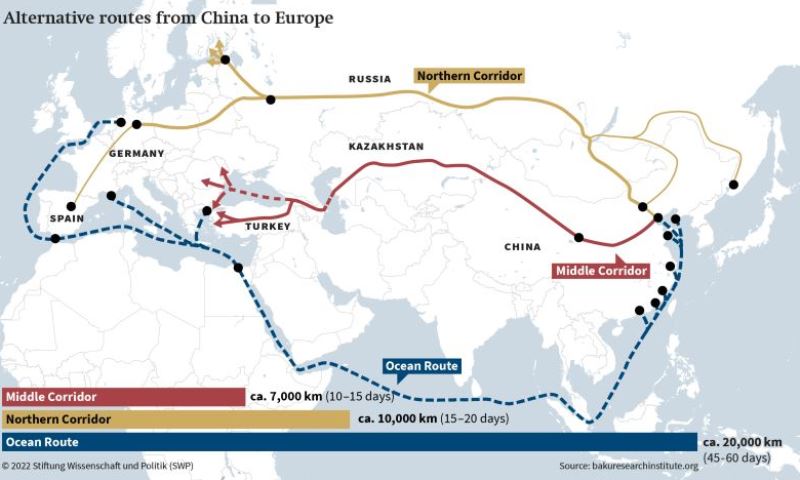
Speaking in Baku in April, Kazakhstan Prime Minister Olzhas Bektenov confirmed the country’s willingness to join the corridor project and emphasized the importance of integrating the TRIPP route with the rapidly expanding Middle Corridor. He also noted growing interest among Kazakh companies in railway construction and infrastructure modernization, signaling that Astana views the initiative as a strategic component of a broader Eurasian connectivity framework rather than merely a transport project.
The proposed corridor would connect Azerbaijan with its exclave of Nakhchivan, Türkiye, and onward to European markets. While discussions around the route were previously focused on Armenia-Azerbaijan normalization and regional integration, recent developments suggest the project is evolving into a larger geopolitical and economic initiative. The emergence of the TRIPP framework, increased U.S. involvement in South Caucasus diplomacy, and Kazakhstan’s expressed interest have elevated the corridor’s significance beyond regional considerations.
As Central Asia’s largest economy, accounting for approximately 60% of the region’s GDP in 2025, Kazakhstan brings substantial economic weight to the project. The country handled around 42,000 TEU of containerized cargo through the Trans-Caspian International Transport Route (TITR) last year, including more than 350 container trains originating from China. Its participation could significantly enhance cargo flows between Central Asia and Europe.
Kazakhstan has also invested heavily in strengthening its transport infrastructure. By 2030, the government plans to modernize nearly 5,000 kilometers of railway lines and rehabilitate another 11,000 kilometers. Major projects, including the Dostyk–Moiynty railway expansion and the new Moiynty–Kyzylzhar line, are expected to boost capacity along key east-west corridors. At the same time, container turnover at Aktau Port surged from 16,387 TEU in 2023 to 54,923 TEU in 2024, underscoring the country’s growing role as a regional logistics hub.
Analysts note that Kazakhstan’s support could provide the economic scale that many regional infrastructure initiatives often lack. By linking the TRIPP route with Central Asia’s largest economy and expanding Trans-Caspian transit networks, Astana could help transform the project into a vital component of Eurasian trade architecture.
The move also reflects the deepening strategic partnership between Kazakhstan and Azerbaijan. Over the past decade, both countries have invested extensively in infrastructure supporting east-west trade, including the expansion of the ports of Aktau, Kuryk, and Alat, as well as the development of TITR. Bilateral trade reached approximately $470.7 million in 2025, with transport connectivity emerging as a key pillar of economic cooperation.
Rather than competing with existing routes through Georgia and the Black Sea, Kazakhstan views TRIPP as a natural extension of the Middle Corridor. Officials have explicitly linked the future growth of the Middle Corridor to the opening of the new route, suggesting that both transport corridors are part of an integrated Eurasian connectivity system designed to improve access to Türkiye, the Mediterranean, and European markets.
The timing of Kazakhstan’s interest is also shaped by shifting geopolitical realities. Since Russia’s invasion of Ukraine in 2022, governments across Eurasia have accelerated efforts to diversify trade routes and reduce dependence on traditional transit corridors. Repeated disruptions affecting the Caspian Pipeline Consortium (CPC) route, which carries the majority of Kazakhstan’s oil exports through Russia, have reinforced Astana’s determination to secure alternative transport pathways.
Cargo volumes along the Middle Corridor have grown from around 1.5 million tonnes in 2022 to more than 5 million tonnes in 2025, highlighting the increasing importance of alternative east-west trade routes. However, experts argue that Kazakhstan’s interest in TRIPP is driven not only by recent geopolitical tensions but also by long-term trends, including rising competition for critical minerals, supply chains, and strategic trade corridors.
Kazakhstan’s participation could also reshape the geopolitical dynamics surrounding the project. Without Kazakhstan, TRIPP remains largely a South Caucasus initiative. With Astana on board, the corridor becomes increasingly integrated into wider Eurasian trade networks, enhancing its strategic relevance for stakeholders including Azerbaijan, Türkiye, the United States, the European Union, and China.
For Beijing, the development presents both opportunities and challenges. China stands to benefit from a more efficient westward trade route, but Kazakhstan’s involvement could also increase the influence of other regional and global actors in shaping the corridor’s future. Similarly, Georgia’s role as a Black Sea gateway could become even more critical as Central Asian trade volumes increasingly rely on interconnected regional transport networks.
Kazakhstan’s announcement ultimately reflects a broader shift in how the country views the future of Eurasian connectivity. More than a transport initiative, the TRIPP corridor is increasingly emerging as a strategic platform linking trade, infrastructure, and geopolitics across the continent. Astana’s interest may therefore signal not only support for a new corridor, but the beginning of a new phase in the evolution of Eurasian commerce and connectivity.