
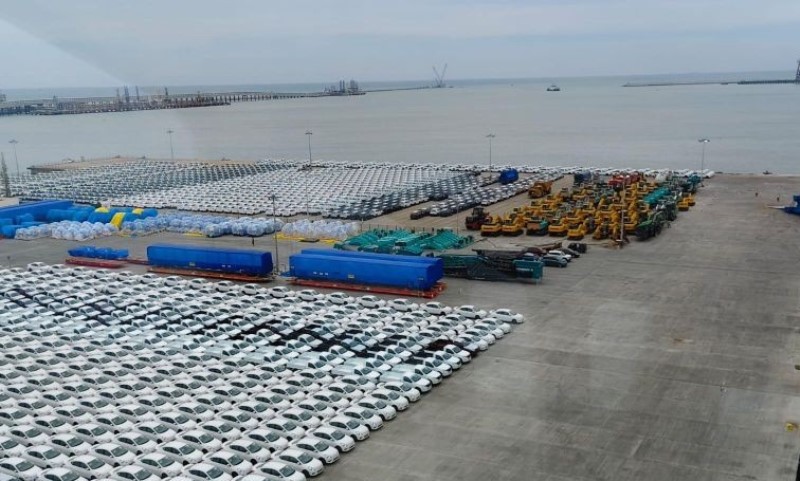
The Union government has set a December 2026 deadline to finalise a comprehensive plan to corporatise 11 of India’s 12 state-owned major ports, with a target to list them on stock exchanges by December 2027, according to a document.
The move marks the next major reform push in the port sector under the Narendra Modi-led government, which has initiated discussions to transition the ports from their current structure as statutory ‘authorities’ into corporate entities.
At present, Kamarajar Port Ltd is the only state-owned major port operating as a company under the Companies Act. Located at Ennore near Chennai, it serves as the reference model for the proposed overhaul.
The document notes that Chennai Port Authority is evaluating the transition into a corporate entity as a pilot case. In 2020, the Centre sold its 67 per cent stake in Kamarajar Port Ltd to Chennai Port Authority for ₹2,383 crore through a government-to-government disinvestment deal, making it a wholly owned subsidiary of the authority.
Governance Model Under Review
The Ministry of Ports, Shipping and Waterways (MoPSW) is currently assessing the optimal governance framework for corporatised ports. A January document calling for a “time-bound action plan for corporatisation of major ports” outlines two broad approaches — centralised and decentralised models.
Centralised models, as seen in countries such as Singapore, Indonesia and Saudi Arabia, promote uniform governance, economies of scale and coordinated strategic development.
In contrast, decentralised models followed in Netherlands and Malaysia provide greater autonomy to individual ports in operational, financial and investment decisions, fostering local responsiveness and innovation.
From a legal standpoint, MoPSW is examining relevant provisions under the Major Port Authorities Act, 2021 and frameworks under the Department of Investment and Public Asset Management to ensure compliance with statutory and investment regulations. The stated objective is to create a robust governance and legal structure that enables ports to operate as competitive and commercially agile entities while safeguarding public interests.
Efficiency and Capital Access
India’s 12 major ports, including Kamarajar Port Ltd, handled a combined 853.57 million tonnes of cargo in FY25.
According to the document, corporatisation would transition ports from traditional government department structures to autonomous corporate entities, enabling faster and commercially driven decision-making by reducing bureaucratic processes.
Corporatised ports would also gain greater financial flexibility, including the ability to independently raise funds, attract private investment and potentially access capital markets through public listings. The corporate structure would facilitate participation by private investors, allowing ports to invest in modern infrastructure, technology upgrades and advanced logistics systems.
Unions Oppose Fresh Push
The government had earlier explored corporatising major ports along the Kamarajar model as part of a broader structural overhaul aimed at enabling them to compete more effectively with privately run ports. However, strong opposition from port unions led to the adoption of the ‘authority’ model instead.
The enactment of the Major Port Authorities Act, 2021 granted greater autonomy and flexibility to the 11 state-owned ports to professionalise governance and enable quicker decision-making.
The renewed corporatisation effort comes at a time when the influence of port workers’ unions has weakened significantly due to a sharp decline in workforce numbers over the past decade.
T Narendra Rao, General Secretary of the Water Transport Workers’ Federation of India, affiliated with the Centre of Indian Trade Unions, alleged that the government is leveraging the reduced bargaining power of unions to push the reform agenda.
Rao said workers’ federations are “determined to fight” the government’s plan to list and potentially privatise major ports, arguing that the move could undermine their structure as state-owned entities and affect workers and pensioners.
He also flagged security concerns, noting that key ports such as Cochin, Mormugao, Visakhapatnam and Mumbai are located near naval bases and serve as critical assets for national safety and security. According to union representatives, any move towards privatisation could compromise these strategic interests.
The Centre’s proposed corporatisation plan is expected to trigger fresh debate over balancing commercial competitiveness, fiscal efficiency and strategic national considerations in India’s port sector.