
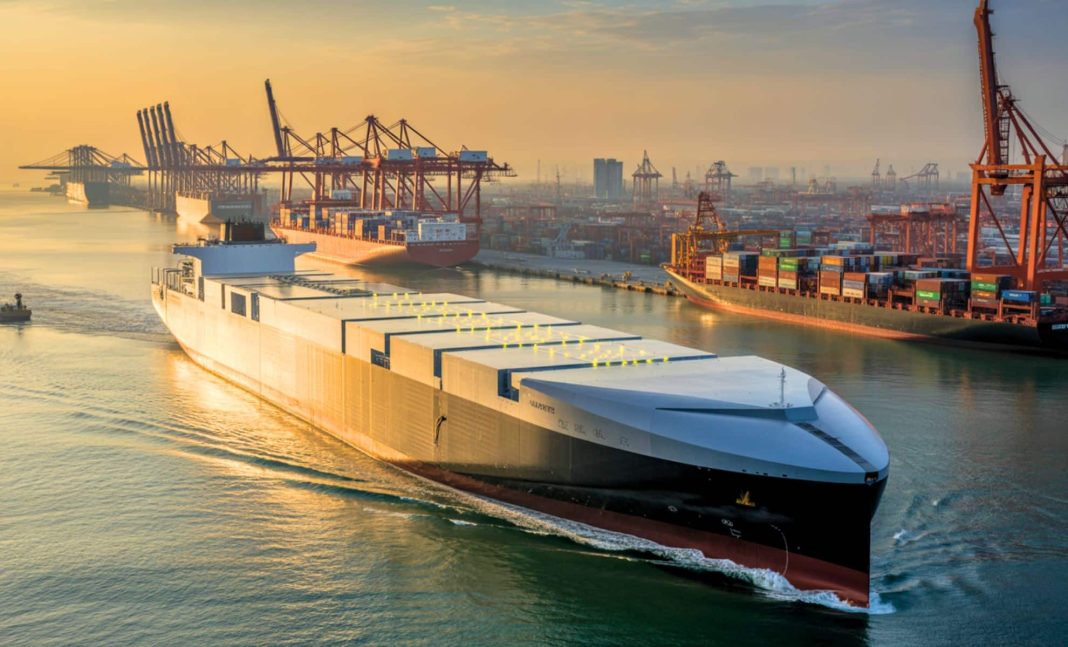
China has revealed a bold concept for what could become the world’s most advanced nuclear-powered merchant vessel—a 14,000-container cargo ship fueled not by uranium, but by thorium, a long-discussed alternative often touted as cleaner, safer, and more abundant. The design, showcased recently by Jiangnan Shipbuilding Group chief engineer Hu Keyi, underscores Beijing’s strategy to leapfrog Western maritime and energy technologies as it races toward carbon neutrality, energy security, and maritime dominance.
At the heart of the vessel lies a 200-megawatt molten salt reactor—similar in thermal output to the power source of the U.S. Navy’s Seawolf-class submarines. Unlike traditional nuclear propulsion systems, the thorium molten salt reactor (TMSR) generates power through a supercritical CO₂ (sCO₂) Brayton-cycle turbine, producing roughly 50 megawatts of electricity at up to 50% efficiency. Conventional steam-cycle reactors operate at about 33%.
The reactor runs at atmospheric pressure, requiring no water for cooling and eliminating many of the bulky, complex systems found on conventional nuclear vessels. It features two passive heat removal systems and a fail-safe enclosure where molten salt fuel solidifies in the event of overheating—automatically containing radioactive material without human intervention. Each reactor module is sealed for 10 years of operation before being removed and replaced as a unit, reducing refueling risk and maintenance complexity.
From the Gobi Desert to Blue Water
China’s maritime nuclear vision builds directly on the success of its land-based thorium molten salt reactor in the Gobi Desert, which in 2025 became the world’s first to achieve long-term stable operation. That project demonstrated the ability to convert thorium into uranium-233 at a meaningful scale—an elusive milestone for global nuclear research.
With some of the world’s richest thorium deposits in Inner Mongolia, Beijing sees the fuel as a key to long-term supply security, insulating its energy ambitions from global uranium markets.
The thorium cargo vessel is part of a broader nuclear-powered maritime ecosystem China is cultivating, including a Suezmax tanker driven by a lead-bismuth fast reactor and a floating nuclear facility based on high-temperature gas-cooled reactors. Together, they outline a sweeping long-term plan to establish nuclear propulsion as a cornerstone of China’s maritime future.
Promise Meets Politics
Despite its promise, the thorium-powered cargo ship remains a paper concept. No construction timeline has been announced, and regulatory approval for nuclear-powered commercial vessels remains a major global challenge.
Even if the technology is ready, the economics are daunting. As Hu Keyi noted in comments summarized by Marine Insight, nuclear-powered ships are far more expensive to build, insure, and operate than conventional ones. The absence of international insurance norms, nuclear-qualified maritime crews, and standardized liability frameworks further complicates their path to commercial viability.
Global politics pose additional obstacles. Port state controls in major markets—including the U.S., Europe, and parts of Asia—remain cautious about admitting nuclear-powered merchant vessels, no matter the fuel. The International Maritime Organization (IMO) has yet to establish a comprehensive framework for such ships.
Thorium reactors may carry lower nuclear proliferation risks than their uranium-based counterparts, but the absence of standards for transporting or disposing of thorium reactor modules leaves environmental regulators wary.
A High-Stakes Bet for Global Shipping
Thorium-powered vessels have been discussed since the 1960s, but no nation has yet brought one to commercial fruition. China’s concept may be the closest the industry has come to a breakthrough—yet the gap between concept and ocean-ready deployment remains vast.
If successful, the ship could represent a historic transformation: decarbonized long-haul shipping, virtually unlimited range, and new strategic autonomy for nuclear-powered fleets. But if it stalls, it may reinforce long-standing concerns that thorium reactor technology, while elegant in theory, remains costly and impractical at scale.
China’s next steps will determine whether thorium shipping becomes a cornerstone of maritime innovation—or remains an ambitious footnote. Turning a reactor proven in the desert into a vessel capable of safe, sustained, international operations is a test not only of engineering, but of global political will.
Should China succeed, the ripple effects are clear: the global maritime order will not merely shift. It could be rewritten.