
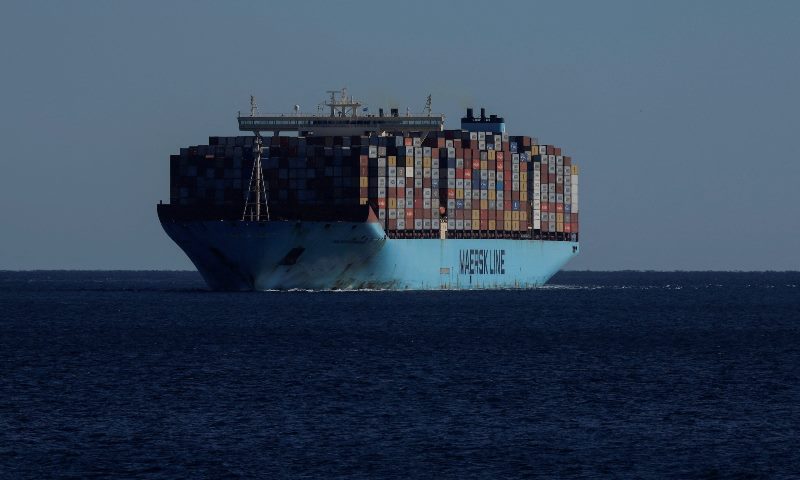
A.P. Moller–Maersk has confirmed that its U.S.-flagged roll-on/roll-off vessel Alliance Fairfax was among the ships escorted by the U.S. military through the Strait of Hormuz earlier this week, marking a significant early test of Washington’s efforts to reopen the critical shipping corridor.
In a statement, Maersk said the vessel—operated by Farrell Lines—successfully exited the Persian Gulf on May 4 “under U.S. military protection,” completing the transit without incident and with all crew members safe.
The ship had remained stranded in the Gulf since late February, when hostilities between the United States and Iran severely disrupted commercial shipping through the strait due to missile, drone, and mine threats.
According to Maersk, the transit followed a coordinated security plan developed with U.S. military authorities. “MLL was contacted by the U.S. military and offered the opportunity for the vessel to exit the Gulf under U.S. military protection,” the company said, adding that both shore-based and onboard leadership approved the operation.
The development supports earlier statements from United States Central Command that two American-flagged merchant vessels had safely transited the strait under the Trump administration’s initiative known as Project Freedom. The second vessel involved has not yet been identified.
Announced by Donald Trump, Project Freedom has been framed as a humanitarian effort to assist vessels stranded in the region amid escalating tensions. Trump stated that several ships were facing shortages of food and essential supplies, prompting requests for U.S. assistance from multiple countries.
However, industry bodies have cautioned that the broader security environment remains largely unchanged. BIMCO warned that there is still limited clarity on how the initiative will function beyond isolated escorted movements.
Jakob Larsen, BIMCO’s Chief Safety & Security Officer, noted that without formal coordination with Iran, risks to commercial shipping persist. He warned that attempts to transit the strait without Iranian approval could trigger renewed hostilities, raising concerns over the sustainability of the U.S.-led effort.
“The overall security situation for the shipping industry is currently unchanged,” Larsen said, urging shipowners to maintain strict risk assessments.
Adding to concerns, a recent incident involving the Panama-flagged cargo vessel HMM Namu has underscored ongoing dangers. South Korea authorities are investigating an explosion and fire reported onboard the ship while transiting the strait. While no casualties were reported, the cause of the engine room fire remains unclear, with the possibility of an attack not ruled out.
The incident highlights the fragile conditions in the Strait of Hormuz, suggesting that despite limited progress under Project Freedom, a full resumption of normal commercial shipping remains uncertain.