
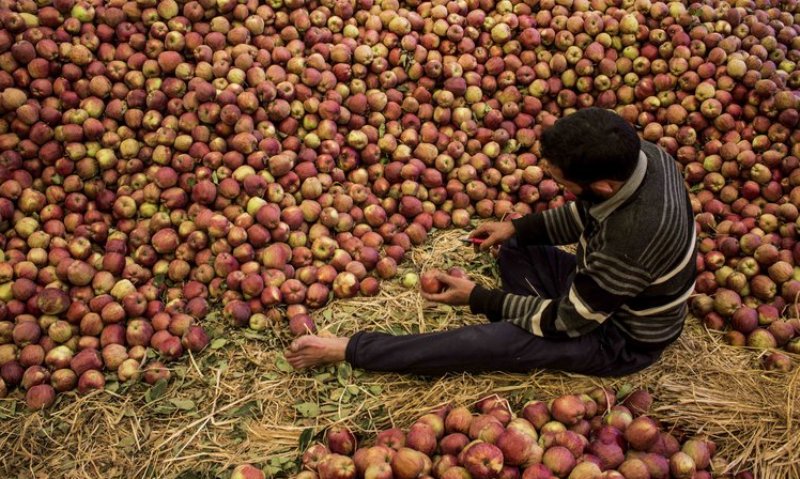
More than 20,000 tonnes of apples have been transported from Kashmir by rail since cargo services were introduced in the Valley in September 2025, signalling a significant shift in freight movement from the region, officials said.
Cargo rail operations were formally launched on September 15, when Jammu and Kashmir Lieutenant Governor Manoj Sinha flagged off the first train, an event described by officials as a historic milestone for the Union Territory’s transport infrastructure.
Reviewing the performance of Northern Railway in Jammu and Kashmir during 2025, Uchit Singhal, Senior Divisional Commercial Manager of the Jammu division, said the movement of apples and cement had emerged as major success stories. To support fruit growers and traders, the Joint Parcel Product–Rapid Cargo Service was introduced specifically for transporting apples from the Valley.
“Since the service was flagged off on September 15, there has been no looking back. With the Anantnag goods shed combined, more than 20,000 tonnes of apples have been transported by rail,” Singhal said.
Officials said the introduction of rail cargo services has reduced the region’s dependence on road transport, which until recently was the sole mode of moving fruit to markets across India and to neighbouring countries such as Bangladesh and Nepal. Frequent disruptions on the Jammu–Srinagar National Highway had earlier resulted in heavy losses for apple growers and traders.
Apart from outbound apple consignments, railways have also facilitated the movement of essential commodities into the Valley. Singhal said more than 1.5 lakh tonnes of cement have been transported by rail since August 9. Automobile rakes were handled for the first time, while foodgrains supplied by the Food Corporation of India were successfully moved by rail on December 21. Other cargo moved included plastic crates, insulated panels and salt.
Passenger rail services also recorded steady growth during the year. Singhal said that since Prime Minister Narendra Modi flagged off the Vande Bharat Express on June 6, nearly 3.75 lakh passengers have travelled on the two pairs of trains operating in the region.
The rail network also played a key role in crisis management. Singhal said special trains and coach augmentations were arranged following the Pahalgam attack, with a 24×7 situation room set up to monitor operations. During Operation Sindoor, close coordination was maintained with civil and military authorities, while flood relief special trains, including the Katra–Sangaldan service, were operated under challenging conditions after August 26.
Meanwhile, ticket-checking drives conducted between April and December 2025 generated substantial revenue. Singhal said 54,098 passengers travelling without valid tickets or irregularly were identified during the period, resulting in collections of about Rs 3.73 crore.
Looking ahead, he said the Jammu division will focus on increasing revenue through sustained ticket-checking campaigns in 2026, while prioritising passenger-centric measures such as improved transparency, prevention of ticket fraud and wider adoption of digital payments.