
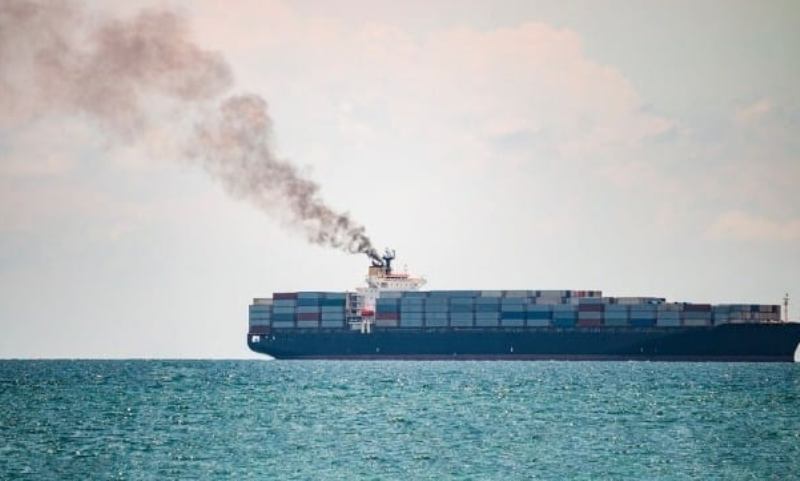
For the past 13 years, Sea-Intelligence has diligently analyzed the online carbon emissions calculators offered by ocean carriers, and over time, the firm has consistently uncovered significant discrepancies in the results these tools provide.
“We did this exercise once again, focusing on Ocean Alliance, as all member carriers have publicly available carbon calculators. We specifically looked at shipping 1 TEU on Shanghai-Rotterdam,” stated Alan Murphy, CEO of Sea-Intelligence.
When Sea-Intelligence examined CMA CGM’s calculator, it provided results for three out of the five Ocean Alliance services. The remaining two services were excluded because they serve Rotterdam-Shanghai on the backhaul due to their routing sequence.
Evergreen and OOCL, on the other hand, included measurements for all five services, with OOCL even factoring in their non-alliance LLX service. COSCO was the exception, offering a single measurement for their AEU3 service.
However, this is misleading because the cargo is transported on the same underlying vessel, and the large difference is primarily due to CMA CGM’s use of the Well-to-Wake methodology, according to Sea-Intelligence report.
“If we keep CMA-CGM out of the comparison to avoid this specific issue and instead only benchmark OOCL with Evergreen, we get a hypothetical savings in carbon emissions of up to 42%. Again, this is simply not possible, as the service is the same,” noted Murphy.
This highlights the fact that it’s nearly impossible for shippers to rely on carriers’ carbon calculators for any meaningful comparative analysis.
“However, over the years, the carriers have begun diverting even more in their methodological choices, bringing us to a point, where it is now even less informative from a comparative standpoint than 13 years ago, when we first did this analysis,” pointed out Murphy.