
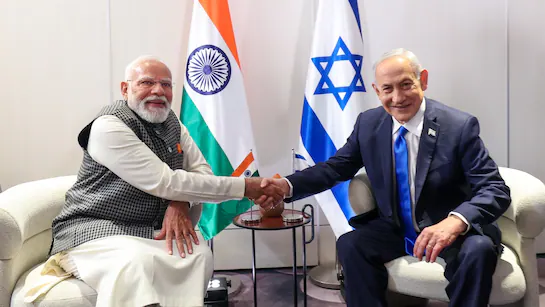
Prime Minister Narendra Modi’s two-day visit to Israel has marked a decisive shift in bilateral ties, elevating the relationship to a “special strategic partnership” and signalling a move toward a more structured, outcome-driven engagement across defence, technology, trade and security.
The visit — Modi’s second to Israel since 2017 — came amid continued instability in West Asia and intensifying global competition in critical and emerging technologies. Both sides framed the engagement as rooted in trust, democratic values and long-term strategic convergence.
Strategic upgrade with concrete deliverables
Announcing the elevation in ties, Modi said the two countries had decided to grant their “time-tested” relationship the status of a special strategic partnership. The joint statement described the partnership as anchored in democratic principles, humanitarian values and deep mutual trust.
The upgraded status was reinforced by substantive outcomes. India and Israel signed 16 agreements and issued 11 key announcements spanning trade, agriculture, energy, cyberspace, digital payments and artificial intelligence (AI).
A key highlight was a memorandum of understanding on cooperation in AI, with both sides agreeing to deploy the technology for public welfare applications. Modi also announced the launch of a Critical and Emerging Technologies Partnership covering AI, quantum technologies and critical minerals — sectors increasingly central to economic competitiveness and national security.
Defence and counter-terror alignment
Defence cooperation remained a central pillar of the engagement. The two sides agreed to expand joint development and joint production of military hardware under technology transfer frameworks, deepening an already robust defence partnership.
Emphasising shared security concerns, Modi stated that India and Israel stand “shoulder-to-shoulder” in opposing terrorism and its supporters. “There is no place for terrorism in the world,” he said, underscoring the strategic alignment between the two nations.
Israeli Prime Minister Benjamin Netanyahu announced that the two governments would convene a government-to-government meeting in India at the earliest opportunity, signalling intent to institutionalise cooperation at higher levels.
Trade push and worker mobility
Economic engagement featured prominently, with both sides reaffirming their commitment to conclude a mutually beneficial free trade agreement (FTA). The first round of FTA negotiations concluded on February 26, and Israeli officials have indicated optimism about finalising the deal within the year.
Bilateral merchandise trade stood at $3.62 billion in FY 2024–25. In a move aimed at strengthening people-to-people ties and economic collaboration, Israel agreed to allow 50,000 additional Indian workers over the next five years, particularly in manufacturing sectors.
Digital payments and financial connectivity
A significant digital outcome was the signing of an MoU between NPCI International and MASAV to introduce India’s Unified Payments Interface (UPI) in Israel. The initiative will explore linking UPI with Israel’s fast payment system to enable seamless cross-border remittances and deepen financial connectivity.
The two countries also launched an India–Israel Financial Dialogue and agreed to expand cooperation in cybersecurity, including the establishment of an India–Israel Centre of Excellence in Cybersecurity in India.
West Asia and Gaza
On regional issues, Modi expressed support for peace efforts in Gaza, noting that humanity must not become a victim of conflict. He welcomed recent diplomatic initiatives and reiterated that India’s security and economic interests are closely tied to stability in West Asia.
Taken together, the visit repositioned India–Israel ties as a forward-looking strategic partnership — shaped not only by shared security concerns but increasingly by collaboration in critical technologies, digital innovation and resilient economic linkages.