
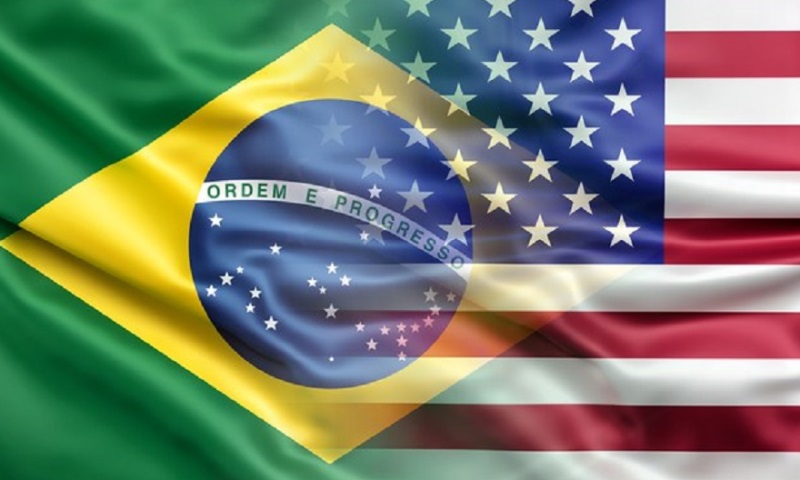
President Donald Trump has announced that the US will impose a 50 per cent tariff on all Brazilian imports.
The new tariffs will take effect on 1 August, with Trump framing the move as a response to what he described as a politically motivated “witch hunt” against Bolsonaro, who faces charges related to an alleged coup attempt.
Reuters revealed that in a letter addressed to Brazilian President Luiz Inácio Lula da Silva, Trump criticised Brazil’s judiciary, accusing it of undermining democratic institutions.
He stated the tariffs were imposed “due in part to Brazil’s insidious attacks on free elections , and the fundamental free speech rights of Americans.”
Trump warned that the 50 per cent tariff was “far less than what is needed to have the level playing field we must have,” and suggested that additional economic measures could follow if Brazil retaliates.
The Brazilian government swiftly condemned the tariffs, calling them an abuse of sovereignty.
Lars Jensen, CEO of Vespucci Maritime, weighed in on the development, linking the tariff hike directly to political motivations surrounding Bolsonaro’s trial.
He noted Brazil’s stated intention to retaliate with proportional countermeasures, warning that this tit-for-tat escalation could severely disrupt global trade dynamics.
Jensen said: “These sharp increases, particularly on Brazil, are politically motivated. Brazil’s response under its new law means we can expect reciprocal measures that will complicate trade flows further.”
He added that such volatility creates uncertainty for shipping lines and ports, forcing rapid adjustments in capacity and service routes.
The impact on maritime logistics is already being felt. Mediterranean Shipping Company (MSC) has suspended its Pearl service, while Maersk has reduced its Peak Season Surcharge (PSS), reflecting efforts by carriers to manage costs amid shifting trade patterns and demand.
This latest move adds to an expanding list of US trade conflicts involving Brazil, China, and the EU, deepening concerns over global supply chain stability.
Ports handling Brazilian exports to the US may experience fluctuating container volumes, while carriers reconfigure operations to mitigate risks.
Thailand recently submitted a new trade proposal to the US in an effort to avoid a proposed 36 per cent tariff on its exports. According to Reuters, the plan aims to eliminate tariffs on a wide range of US imports and reduce Thailand’s $46 billion trade surplus with the US by 70 per cent within five years, with the goal of achieving balanced trade within seven to eight years—an accelerated timeline compared to earlier proposals.