
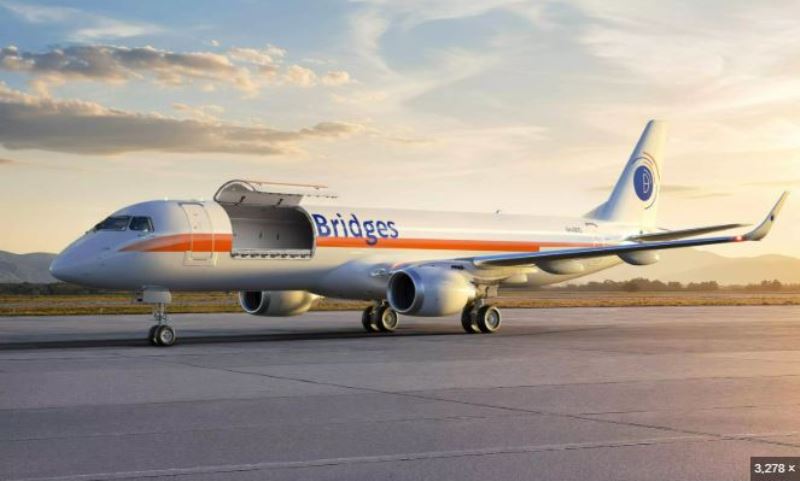
At the 2025 Paris Air Show, Brazilian aircraft manufacturer Embraer announced a major milestone in its cargo portfolio with the official launch of its E190F passenger-to-freight (P2F) conversion. The launch customer is Bridges Air Cargo, part of Bridges Worldwide, a long-standing express logistics provider with deep partnerships across FedEx, DHL, and UPS networks. The announcement, made alongside lessor Regional One, marks the commercial debut of Embraer’s much-anticipated regional freighter.
Meeting the Demands of E-commerce and Regional Trade
The E190F was designed to meet the evolving needs of e-commerce and modern trade logistics, where demand is growing for fast, frequent deliveries to decentralized hubs. With the rise of same-day and next-day delivery expectations, regional express routes to secondary and tertiary cities are becoming increasingly critical. Turboprops have long served this segment, but Embraer saw an opportunity for a more capable, cost-efficient jet solution, and the E190F is their answer.
According to Embraer, the converted E-Jet freighter offers over 40% more cargo volume than large turboprops, has three times their range, and delivers up to 30% lower operating costs than larger narrow-body freighters like the Boeing 737-800BCF. It strikes a balance between agility and performance, offering a payload capacity of around 13,500 kg with the ability to operate from short runways.
A Strategic Move by Bridges Air Cargo
For Bridges Air Cargo, the timing is symbolic. “It’s fitting that Bridges becomes the launch customer for the E-Freighter as we celebrate 35 years of operations and over a billion kilograms moved for the express market,” said Guy Bridges, Managing Director of the airline. “The aircraft’s size fills a unique and underserved space in the cargo segment. It strengthens our operational capability and paves the way for the development of promising new routes.”
This strategic move will allow Bridges to further support its global logistics partners, enhancing the efficiency of time-critical shipments and helping meet the growing demands of B2B and B2C express customers. With regional jet freighters now entering the market, the company is positioned to pioneer new intraregional cargo corridors that turboprop constraints have historically limited.
Inside the E190F Conversion
The E190F and its sibling, the E195F, are part of Embraer’s broader E-Freighter program launched in 2022. The conversion involves installing a large forward cargo door, reinforcing the main deck floor, integrating a cargo loading system, and reconfiguring safety systems to handle hazardous materials. Embraer says the aircraft can accommodate up to 10 ULD containers on the main deck and 3 LD3 containers in the lower hold.
The aircraft offers a range flexibility of up to 2,300 nautical miles (4,260 km), making it ideal for hub-and-spoke models or direct point-to-point routes within regions such as Southeast Asia, Europe, South America, or the Indian subcontinent.
A Market Ready for Disruption
While wide-body freighters have captured most of the attention in the past decade, there’s a growing realization that the next phase of air cargo growth will be regional and fast-moving. That’s where Embraer’s E-Freighter fits in. According to the company, there are over 700 potential aircraft in the market that could be converted over the next 20 years.
This launch also comes at a time when many early-generation E-Jets are reaching the end of their passenger lifecycle. The P2F program gives lessors and operators like Regional One a valuable second life for these airframes—bringing sustainability, reduced capital investment, and operational efficiency all at once.
Looking Ahead: New Routes, New Possibilities
Bridges Air Cargo is expected to take delivery of its first E190F later in 2025, with Embraer having already secured certification from Brazil’s ANAC, the FAA, and most recently, EASA. This positions the aircraft for global deployment from day one.
The arrival of the E-Freighter opens up opportunities to serve fast-growing regional routes with higher frequency and better economics, particularly in markets where demand is not yet large enough to justify full narrow-body operations. For airlines seeking flexibility, speed, and cost-effectiveness, the E190F could soon become a fleet staple.