
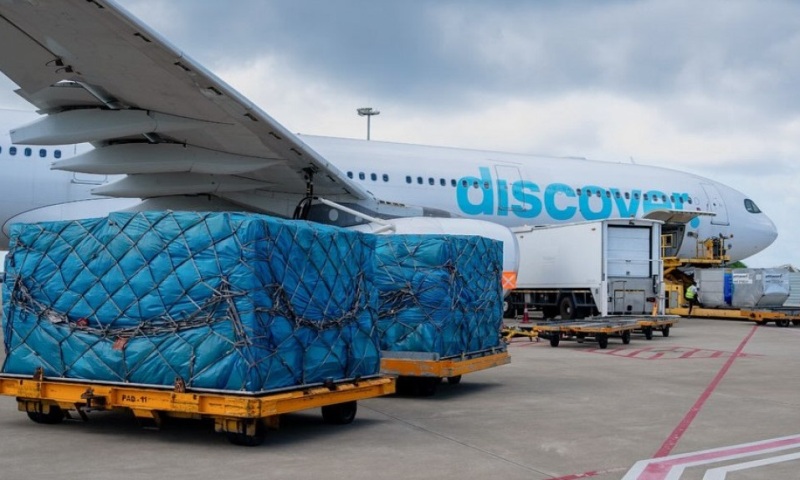
In August 2025, global air cargo demand measured in cargo tonne kilometers grew 4.1 percent compared with the same month last year.
International operations performed even stronger with a 5.1 percent increase. Although this represented a slight slowdown from the 5.5 percent growth recorded in July, the market maintained six consecutive months of year-on-year expansion, reflecting continued resilience.
Global capacity, tracked through available cargo tonne kilometers, expanded by 3.7 percent. Cargo load factor edged up by 0.2 percentage points to reach 44.2 percent, showing improved utilization levels.
Regionally, Africa led with an 11 percent surge in demand, its second month of double-digit growth. Asia Pacific carriers followed with a rise of 9.8 percent. Europe and Latin America reported more modest gains of 3.2 percent and 2.1 percent. The Middle East saw an increase of 2.7 percent. North America was the only market to contract, falling 2.1 percent compared with last year.
Trade lanes reflected the effect of new tariff structures, particularly changes in the United States and the removal of the de minimis exemption.
The Europe to Asia route grew by 13 percent and within Asia by 12.4 percent, driven by a shift of Asian cargo away from North America. In contrast, traffic between Asia and North America fell by 2.2 percent.
Africa also featured strongly in global flows. Africa to Asia volumes increased 8.4 percent, while Africa to Middle East rose 15.6 percent.
Africa to Europe declined by 3 percent. The Europe to North America corridor continued to strengthen with 7.8 percent growth, while volumes between the Middle East and Asia climbed by 7.8 percent to reach record highs.
Capacity growth was strongest in belly hold supply from passenger networks, which expanded by 7.8 percent compared with last year. This marked the fifty-third consecutive month of growth, and belly capacity now represents more than half of global freight supply. Dedicated freighter capacity rose by 2.6 percent.
Trade frictions between North America and Asia prompted airlines to redirect freighter capacity towards high-growth corridors in Europe and Within Asia. Both regions recorded double-digit increases in freighter operations.
Cargo yields declined by 2 percent year on year in August, marking the fourth month in a row of falling yields. This partially offset gains seen during the first quarter of 2025.
Africa and the Asia Pacific continued to outperform as shippers redirected supply chains and demand grew for exports that are not affected by United States tariffs. Strong resilience in the Asia Pacific helped keep global load factors steady, despite weaker results in other markets.
North America was the only region to register a year-on-year decline, impacted by both export and import headwinds. This underlined the broader consequences of trade tensions and supply chain realignments.
August 2025 reaffirmed the adaptability of the global air cargo sector. Despite trade policy uncertainty and structural shifts in demand, the industry sustained its growth momentum. Looking ahead to the final quarter of the year, demand strength, regional realignment, and capacity discipline are expected to remain at the center of industry strategy.