
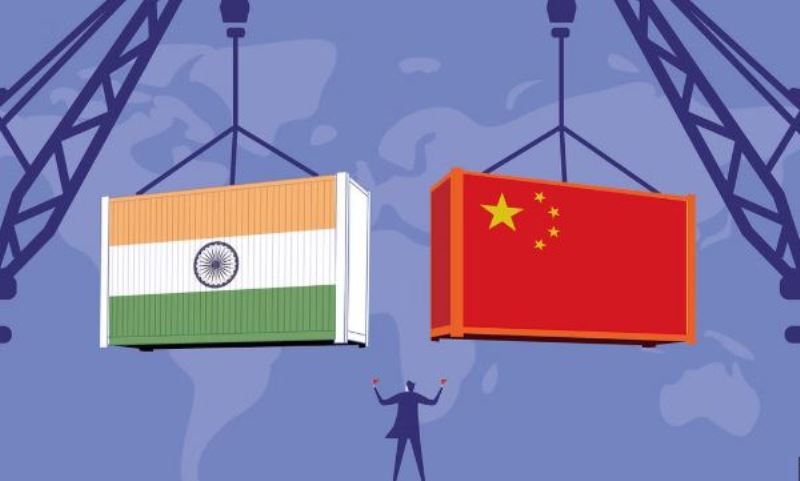
China’s decision to ease export restrictions on fertilisers, rare earths, and tunnel-boring machines for India is a positive step, but self-reliance remains the only durable safeguard for India against its widening trade deficit with China, the Global Trade Research Initiative (GTRI) said in a report.
The think tank cautioned that India cannot overlook its deep reliance on Chinese imports, even as Beijing relaxes some curbs.
The development follows China’s earlier restrictions on critical minerals such as gallium, germanium, and graphite, which disrupted India’s electronics and electric vehicle sectors.
In June 2025, battery major CATL even withdrew engineers from Foxconn’s Chennai plant, halting operations.
Despite the recent easing, the imbalance in bilateral trade remains acute. India’s trade deficit with China hit a record USD 100 billion in FY2025.
The GTRI report underscored that such dependence provides Beijing with significant leverage, particularly in times of geopolitical crises.
The problem, the report argued, is structural. China currently supplies more than 70 percent of India’s requirements in several critical areas.
Everyday consumer products are also dominated by Chinese imports — with laptops accounting for 80.5 percent and flat panel displays 86 percent of India’s purchases.
India’s share in bilateral trade has meanwhile dropped sharply, from 42.3 percent two decades ago to just 11.2 percent today, underscoring weakening supply chain resilience.
To address these vulnerabilities, the GTRI suggested that India adopt a multi-pronged strategy. This includes launching reverse-engineering programmes through IITs and CSIR labs to deconstruct imported goods and develop open-access blueprints.
A proposed ‘Localize-100’ system could track and prioritise the most critical imports for domestic substitution.
While describing Beijing’s relaxation of restrictions as a ‘useful signal’, the report stressed that it cannot disguise the underlying imbalance in the relationship.
“A stronger, more self-reliant India will be better placed to engage China on equal terms, while keeping relations steady and pragmatic rather than hostage to sudden shifts,” it said.
The report concluded that China’s move was tactical, while India’s real safeguard lies in strengthening domestic manufacturing, reducing import dependence, and building resilient supply chains.