
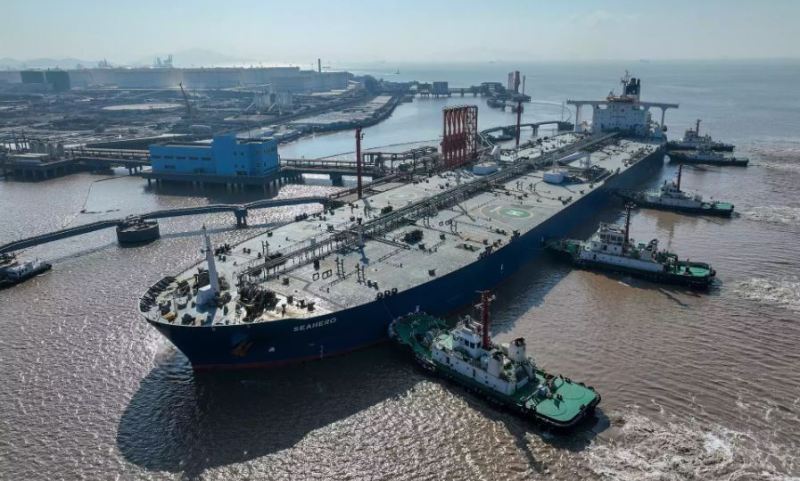
State-owned oil marketing companies have scaled down their vessel requirement for the next 15 years to 59 ships, a sharp reduction from the earlier projection of 112 vessels, dealing a setback to Indian shipbuilders who had anticipated a wave of orders following the Cabinet’s approval of a ₹69,725-crore support package in September. The revised list was finalised during a review meeting chaired by Vijay Kumar, Secretary, Ministry of Ports, Shipping and Waterways, with senior officials of public sector oil companies in October. A government official said the pruning of the requirement was achieved by reducing the number of LR/MR tankers while increasing the count of large vessels such as very large crude carriers, Suezmax and Aframax tankers.
Under the updated plan, the fleet composition sought by Indian Oil Corporation Ltd, Bharat Petroleum Corporation Ltd, Hindustan Petroleum Corporation Ltd and Oil and Natural Gas Corporation Ltd now includes a mix of MR tankers, VLCCs, Suezmax vessels, Aframax carriers, ethane and gas carriers, LNG vessels and offshore support ships. These vessels fall in the range of 0.8 lakh to 3.2 lakh DWT, double or triple the size of LR/MR tankers, and require more advanced technology, higher design sophistication and greater capital investment. Local shipbuilders had requested that these large vessels be classified as specialised ships to qualify for higher assistance under the Shipbuilding Financial Assistance scheme, but the government did not accept this proposal.
Previously, OMCs had indicated a requirement of about 112 vessels valued at ₹85,400 crore over 10–15 years. India currently has only a 0.07 per cent share in global shipbuilding and less than 1 per cent of global shipping capacity. At an event in Bhavnagar on September 20, Prime Minister Narendra Modi stressed that India pays nearly ₹6 lakh crore or $75 billion annually as freight to foreign shipping companies, an amount almost equivalent to the country’s defence budget, because just 5 per cent of India’s EXIM cargo is carried on Indian ships.
The government considers heavy reliance on foreign carriers a strategic and economic vulnerability. Earlier, IOC had been tasked with inviting bids for ten new MR tankers from local shipyards, but the plan did not move forward despite a June deadline set by the Prime Minister’s Office. The Indian National Shipowners Association argued that the existing fleet of more than 30 MR tankers under the Indian flag was adequate to meet current needs and suggested focusing on other tanker segments experiencing shortages.
In response, it was decided that Shipping Corporation of India Ltd will establish a joint venture with IOC, BPCL and HPCL to acquire ships from domestic yards. The JV, led by SCI, aims to strengthen India’s energy security and support the Aatmanirbhar Bharat initiative by encouraging the use of Indian-built vessels. SCI will offer technical, operational and regulatory expertise, while the oil companies will provide long-term cargo commitments. A tender to build two MR tankers is expected to be issued shortly by SCI on behalf of the joint venture.